


|
|
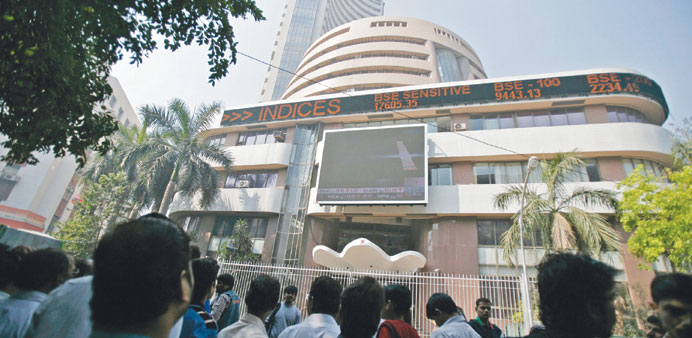
Indian equities fell, dragging a gauge of banks to a 10-month low, on concern the new liquidity tightening measures taken by the central bank to support the rupee will increase borrowing costs.
Yes Bank tumbled the most in more than four years, pushing the S&P BSE Bankex to its lowest level since September. Eight of the 13 stocks on the gauge slumped at least 5%. State Bank of India slid 3.2%, depressing the stock’s price-to-book ratio to 1, the lowest reading since April 2009.
The S&P BSE Sensex retreated 1% to 20,090.68 at the close, after climbing to a 30-month high on Tuesday.
The Reserve Bank of India limited banks’ access to cash and increased the daily balance requirement for the reserve ratio, stepping up efforts to steady the rupee which slid to a record this month. The RBI on July 15 raised two interest rates and moved to drain money through bond sales, joining emerging nations from Brazil to Indonesia in tightening credit to stabilize currencies.
“Profitability of lenders will get hit due to compression in net interest margins, lower economic growth and rising bad loans,” Aneesh Srivastava, chief investment officer at IDBI Federal Life Insurance Co in Mumbai, said in a phone interview yesterday. “Tighter liquidity will hurt economic growth further.”
The rupee strengthened against the dollar yesterday — posting its biggest single-day gain in a month. The currency firmed intraday yesterday to 59.01 to the dollar, from its previous day’s close of 59.76. It ended local trade at 59.12, a one-week high.
Yes Bank plunged 13% to Rs383.35, the sharpest drop since October 2008. The lender’s net income in the three months ended June 30 climbed 38% to Rs4.01bn, according to an exchange filing. That beat the adjusted median estimate of Rs3.79bn in a Bloomberg survey.
The stock was the worst performer on the S&P BSE Bankex, which sank 4.6% to its lowest close since September 14. The gauge has slid 18% from a record reached on May 15.
The recent moves by Reserve Bank Governor Duvvuri Subbarao contrast with his decisions to cut the benchmark interest rate by 25 basis points each in January, March and May, in a bid to fight the weakest economic growth in a decade. He left the rate unchanged at 7.25% in June. The next review is on July 30.
“There’s a halt in the march of private-sectors banks” because of an “about turn” in the central bank’s monetary policy, Raamdeo Agrawal, joint managing director of Motilal Oswal Financial Services in Mumbai, said in an interview to Bloomberg TV India yesterday.
State Bank retreated 3.2% to Rs1,801.25, a seven-month low. ICICI Bank, the nation’s second-biggest lender, lost 3.8% to Rs951.8. HDFC Bank, the biggest by market value, lost 3.5% to Rs659.95.
Engineering company Larsen & Toubro retreated for the fourth day, losing 3.8% to Rs867.35. Maruti Suzuki India, the nation’s largest carmaker, plunged 2.3% to Rs1,416.05. Copper and zinc producer Sterlite Industries (India) tumbled 3.1% to Rs81.95.
The Sensex has climbed 8.3% since June 26, helped by better-than-estimated corporate earnings. Six out the eight index members that have reported earnings so far for the June quarter beat analysts’ estimates. About 27% of companies in the gauge missed forecasts for the three months ended March, compared with 43% in the quarter through December.
The 30-stock gauge trades at 14.1 times projected 12-month earnings, the most expensive since February 2012, compared with the MSCI Emerging Markets Index’s 10.2 times.
Global funds bought $37mn of local shares on July 23, taking this year’s net purchases to $12.4bn, data compiled by Bloomberg show. They have sold a net $961mn of domestic stocks this month, the most among 10 Asian markets tracked by Bloomberg, extending June’s $1.8bn sell-off.
The CNX Nifty Index on the National Stock Exchange of India plunged 1.4% to 5,990.50. India VIX, which gauges the cost of protection against losses in the Nifty, rose 1.1%, ending a four-day slide.
Meanwhile, the RBI accepted a yield of 11.0031% on three-month bills and 10.4649% on one-year paper, the highest yields in at least six years and above market expectations, one week after rejecting all bids as too high.
Its strategy will be further tested with two more debt sales this week to raise a combined Rs210bn, as continuing to accept high yields could prove costly for a country trying to tame its fiscal deficit.
“The higher T-bill yields signal the clear intention of the central bank to pull out liquidity from the system,” said Shakti Satapathy, fixed income analyst at AK Capital. “Though today’s auction were accepted at a higher rates, the sustainability of higher yields wouldn’t be acceptable in the subsequent weeks.”
“The establishment has been telling the nation that the measure is only short term in nature and there is no change in the stance of the central bank on long-term interest rates. Believe it at your own peril,” Jyotheesh Kumar, executive vice-president of HDFC Securities, said in an e-mail to clients.
The benchmark 10-year bond yield hit a 14-month high of 8.5%, up 33 basis points on the day and 95 basis points since July 15.
The overnight cash rate jumped to a four-month high of 10%, before easing back to 8.5%. That was still up around 200 basis points from Tuesday’s close.
Standard & Poor’s already has “negative” outlook on the country’s rating, and a cut would lower it to “junk” status.
The government is considering options of its own, including raising money from citizens abroad in a bid to reduce its record current account deficit.