


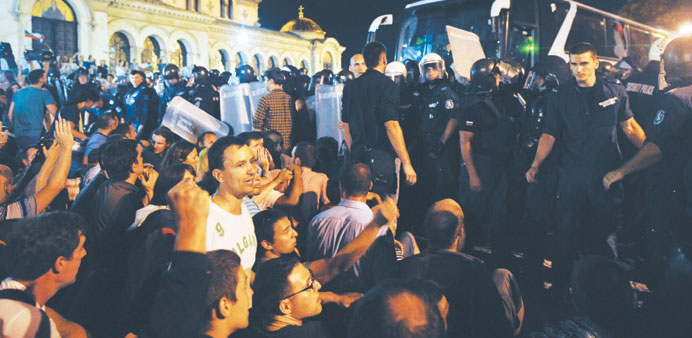
Protesters face Bulgarian riot police officers clearing a path for lawmakers and parliament staff leaving in a bus during an anti-government protest in Sofia late on Tuesday.
Reuters/DPA/Sofia
More than 100 Bulgarian lawmakers, ministers and journalists spent the night besieged inside parliament by anti-corruption protesters before police evacuated them early yesterday in the latest instability in the southeast European state.
A political crisis that began over utility price rises and spread to accusations that private interests control state institutions has caused months of protests in the ex-communist state, which joined the European Union in 2007 but has struggled to live up to its governance standards.
Parliament was closed for business today, barricaded and under heavy police guard, after speaker Mikhail Mikov urged deputies not to go to work until public order is restored.
“The life and health of the people’s representatives cannot be jeopardised,” he said.
Lawmakers were escorted out of the building in police vans around 3am yesterday, more than eight hours after they were trapped inside by protesters shouting “Mafia!” and “Resign!” who tore up paving stones and piling up garbage for makeshift barricades.
European Justice Commissioner Viviane Reding, departing from diplomatic usage, lent open support to the protest movement on Tuesday when she told civil society groups in Sofia: “My sympathy is with the Bulgarian citizens who are protesting on the streets against corruption.”
“Bulgaria must continue its reform efforts,” she added.
Reding also told journalists after a two-hour citizens’ debate that she had encouraged the leading Bulgarian parties to “stop the political quarrelling”.
“When a country is in trouble – and it seems that there are problems to be solved in this country – then it is for the political parties to forget about their fights and to sit down together,” she noted. “Politicians are there to serve the citizens.”
In Brussels, European Commission spokesman Olivier Bailly called for calm on all sides and declined to distance himself from Reding’s comments, saying that what was at stake was public order and the right to demonstrate in Bulgaria.
More than 10,000 mainly well-educated Bulgarians have rallied daily in Sofia for the last 40 days to demand the resignation of the Socialist-led government that took office in May after an inconclusive election.
The movement was sparked by the appointment of an influential media figure to a top security post, which many saw as an example of murky ties between politicians and businessmen.
The government withdrew his nomination but the protests have persisted amid widespread disenchantment with the political class. The previous centre-right government quit in February after mass protests against electricity price rises and failed to return to power after a deadlocked election in May.
The blockade of the parliament was sparked by a government decision to borrow 1bn levs ($676mn), raising the budget deficit to 2% of gross domestic product.
The move is not likely to threaten fiscal stability, but centre-right opposition parties and some analysts see it as an example that this government plans to fuel spending rather than carrying out any significant reforms.
About 30 protesters were drinking coffee in public outside parliament, as they have in the past 20 days, to maintain pressure on the government to resign.
“We want people in the parliament to start thinking about the people, and not only for their own pockets,” said 35-year old Anna Grozdanova, sipping coffee outside a protest tent in front of parliament.
“It is important we send honest and decent people, so that these outrageous appointments and deals stop. They need to think about education, healthcare, how to take Bulgaria forward. Instead we see this government is not doing that,” she said.
Prime Minister Plamen Oresharski’s cabinet has refused to quit and about 500 to 1,000 pro-government supporters have held daily counter-demonstrations in Sofia and about 200,000 people have signed a petition supporting him.
Earlier, police forced a pathway through hundreds of activists in the capital of the poorest EU country to free the trapped lawmakers.
“Police reacted very adequately, officers did their job perfectly although protesters behaved extremely aggressively,” Interior Minister Tsvetlin Yovchev told reporters.
The protests have turned violent with some clashes with police and stone throwing.
Several protesters were treated for head injuries, a hospital official said. Two police officers were also wounded.
“We will try to find those who threw stones at police and deputies,” the minister said.
Ivailo Kalfin, a member of the European parliament and a former foreign minister, wrote on Facebook: “With apologies to the millions, who voted two months ago, we need new elections.”
An earlier attempt to get deputies out of the parliament with a bus led to a scuffle with police. It was aborted after protesters threw bottles, stones and other objects at the bus, while others sat in front of it.