


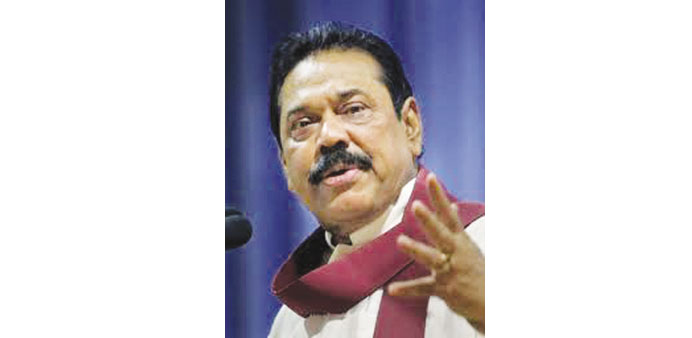
President Mahinda Rajapakse: Giving in to ethnic Tamils’ plea.
AFP/Colombo
Sri Lanka’s military said yesterday it will dismantle over a dozen army camps in the former rebel stronghold of Jaffna, weeks ahead of key council elections in the embattled region.
Military spokesman Brigadier Ruwan Wanigasooriya said 13 camps in Jaffna will relocate to the sprawling Palaly cantonment on the northern edge of the peninsula next month.
“This is yet another step in the ongoing process of relocating the military in the Jaffna peninsula and reducing the presence of troops,” he said.
Sri Lanka’s ethnic Tamil minority as well as rights groups have asked President Mahinda Rajapakse to demilitarise the area which was once ruled by Tamil Tiger rebels as their de facto capital.
Sri Lankan troops crushed Tamil Tiger rebels in May 2009 and ended 37 years of ethnic bloodshed which claimed up to 100,000 lives, but the military has maintained a large presence in the former war zones.
Wanigasooriya said the military had planned to remove the camps even before the government called the council elections in Jaffna which are expected to be held sometime towards the end of September.
The upcoming elections to provincial councils, the highest level of local government, grant a degree of autonomy to Tamils in the Sinhalese-majority nation of 20mn people.
Sri Lanka adopted a de facto federal system in 1987 but never held elections in the Tamil-dominated north, which continued to be ruled directly by the president. Councils have, however, been functioning in Sinhalese-majority areas that Rajapakse’s party controls.
The councils were established in line with an agreement with neighbouring India, which promised to rein in Tamil separatists on its soil provided Colombo shared political power with the Tamil minority.
In a report last week, European parliamentarians’ delegation said Sri Lankan security forces had been deployed for road construction and other work that would normally be carried out by civilians.
“We have raised concerns that the military is becoming a part of everyday life of society,” the delegation head, Britain’s Jean Lambert, said, adding that they believed troops were having an unfair advantage over civilian small businesses.
Sri Lankan troops declared an end to 37 years of ethnic war after wiping out the leadership of separatist Tamil Tiger rebels in May 2009, but defence spending has been maintained with the same level of troops and funding.
Security forces have ventured into the lucrative tourism sector and also deployed in key construction projects of the
government.
Sri Lanka is under international pressure to promote ethnic reconciliation and investigate allegations of war crimes by its forces in the final stages of crushing Tamil Tiger rebels.
It has denied allegations that up to 40,000 civilians were killed during the bloody finale to the conflict.