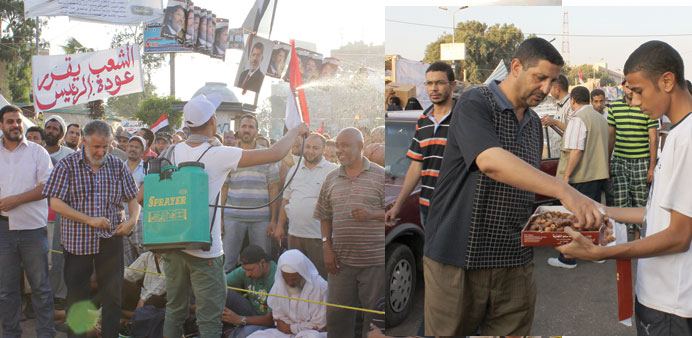
A young man uses a crop-spray device to hose cool water over supporters in eastern Cairo. Right: A young man hands out dates to protesters shortly before the sunset prayers.
By Nehal El-Sherif
After the noon prayers, temperatures increase in Cairo, but that does not deter thousands of Egyptians who have been protesting for more than three weeks demanding the reinstatement of ousted president Mohamed Mursi.
With makeshift tents spread around a major mosque in eastern Cairo, most of the demonstrators sit in the shade fasting as the holy month of Ramadan progresses into the second half. Men and women spend the day reading the Qur’an, chatting or sleeping. Others gather around a stage set up outside the mosque, chanting pro-Mursi slogans.
Dozens were chanting “People support Mursi the president,” as young men sprayed cool water on them to help them bear the heat.
Pictures of Mursi are hanging around the area, and many men like to pose with the posters for photographers. A few hours before sunset, many people arrive at Rabaa al-Adawiya Square bringing food and drinks. They begin distributing dates to protesters, which many faithful like to break their fast with.
Others hand out juices, water bottles, rice, vegetables, beans and bread. “We are a peaceful rally. We do not have weapons. Our weapons are the Qur’an and the dates,” says Saeed, 31.
“We are not terrorists. We want to tell the world we are peaceful,” he adds, while carrying some dates in his hand. Saeed rejects accusations by the anti-Mursi groups that the Islamists in the sit-in are armed. Since the army ousted Mursi on July 3, dozens have been killed in Cairo in clashes between Islamists and their opponents.
More than 50 people were killed outside one of the Republican Guard buildings near the Islamists’ sit-in. The army says its soldiers were attacked by armed groups, while the Islamists say the soldiers opened fire on them while they were praying at dawn.
Seven more people were killed and more than 200 wounded in fighting between Mursi loyalists and police forces in Cairo and around the nearby city of Giza a week later. The Muslim Brotherhood, to which Mursi belongs, has refused to recognise the new interim government that will run the country during a transitional period, expected to last for at least six months.
The brotherhood and their Islamist allies denounced Mursi’s ouster as a coup and vowed open-ended protests until he is restored to office.
Ramadan began in Egypt on July 10, as the country remains more divided than ever. Many Egyptians hope the Islamists will find it hard to continue with their sit-in and sustain the heat while fasting.
“I have been here since June 28, and I will stay until Mursi is back. We are here to defend legitimacy,” said Mohamed Abdul Azim, 45, who came from Mansoura city, some 120km northeast of Cairo.
Abdul Azim says he sometimes accepts the food people give away for Iftar. Other times he buys food from the stalls sellers have set up around the square.
The call to Maghreb starts and people begin drinking water and eating their dates, as some men set off fireworks, to celebrate the end of the fast and alert those sitting away from the mosque.
Men and women line for prayers, and right after they finish they start shouting, “Allah is sufficient for us and He is our Guardian,” a common prayer said by protesters who believed they have been wronged.
These Egyptians blame defence minister and army chief Adel Fattah al-Sissi for the division in the streets. Al-Sissi is the architect of Mursi’s ouster. He defended his move by saying the military’s general command acted on the people’s will after millions took to the streets for several days starting June 30, demanding Mursi’s removal from power.
The deposed president has been detained by the army since then and his whereabouts have been unknown. Prosecutors began investigating complaints against Mursi, Egypt’s first democratically elected president, for inciting violence and espionage. “Say No to Sissi, my president is Mursi” is the most common chant by the protesters.
Under banners reading “Legitimacy” and “No to the coup,” protesters gather on the ground to eat the Iftar meal before getting ready for the taraweeh, prayers performed daily in Ramadan.
They are determined to continue their sit-in. Wearing a beige veil, Eman Mahmoud is carrying the Egyptian flag with her fellow women. The teacher, who brings food and joins protesters every afternoon, says she is optimistic.
“This is the best Ramadan ever,” said the 35-year-old mother of three. “They stole my vote and I want it back. I will keep coming until Mursi is back.”
She does not care if she spends the post-Ramadan Eid al-Fitr feast there. “I will bring the Eid cookies and come celebrate here with my brothers and sisters.”
Outside the Rabaa al-Adawiya square, the streets are empty one hour after Iftar. Amm Hassan, a taxi driver, asks people leaving the square: “How is it? Are they staying to celebrate the Eid like this?”
“Between here and the presidential palace, it seems it will never end,” he said referring to the area where the anti-Mursi protesters rally every Friday in support of Mursi’s ouster and to pressure the interim government to speed up the transitional period. “May God help us all,” said Hassan. — DPA