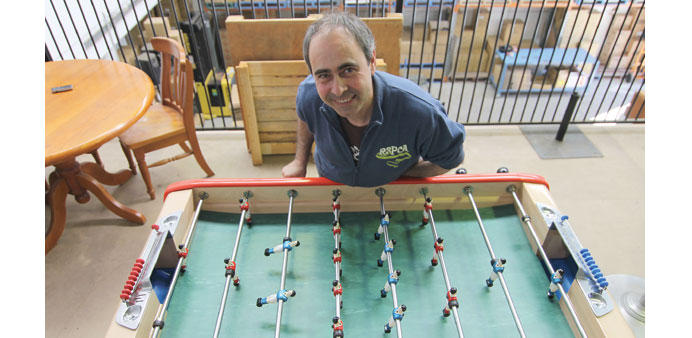
Gilles Gaborit at Sydney’s first foosball clubhouse inside his coffee business in the Sydney
By Sid Astbury
Australians have won Wimbledon, been the world’s top golfer and finished the Tour de France in yellow. Coming tops in table football is something way into the future though.
The national team finished 39th, three places from the bottom, at the World Cup in Nantes, France, in January. Making up the minimum squad of seven were two teenagers. “We got a resounding flogging,” David Morgan chuckled. “But you’ve got to start somewhere.”
Competitive table football — sometimes called foosball — got started in Australia just three years ago when Morgan and two mates built a table and invited friends round to play.
“We got keen and made a silly trophy,” the 46-year-old software engineer said. “We got more keen and broke a few tables.”
There are now 180 players in seven clubs, state championships and national championships. Come the next World Cup, also in France, getting into the national team will take more than just turning up on the day.
At the World Cup in Hamburg, a couple of years later, there might be a big breakthrough.
“For a country with only 30 foosball tables, we’re doing okay,” said Viktor Desovski, whose childhood dream was to play table football for his country.
He learned the game in his native Macedonia and only picked it up again a few years ago. He is Australia’s best player. “The biggest lesson at the World Cup was calming down a bit,” Desovski said. “Your hands are shaking and before you knew it the game was over.”
Like a tennis tournament, there were trophies in Nantes for singles, doubles and mixed doubles. The top spots were taken by the big guns of the game, Germany and France.
Desovski, a real estate agent, sees rapid growth for a game that is cheap to play, open to men and women, and which gives the big and the small an equal chance. “You don’t need the expensive coach or the expensive gear,” he said. “That’s a really big positive for young kids who may want to have a break from the Nintendo and the PlayStation.”
A sport in its infancy in Australia is huge abroad. The United States and Europe have professionals. Germany alone has 60,000 registered players.
Gilles Gaborit is a French-born Australian coffee-company boss who recently rekindled his childhood passion for the game. He opened Sydney’s first table-football club in November.
Gaborit honed his skills on Bonzini tables — one of five makes sanctioned for competition by the International Table Soccer Federation (ITSF) — and is getting up to speed on the China-made Fireball tables that Foosball Australia has adopted as its standard.
The World Cup was a multi-table tournament, with the French playing half their games on their beloved Bonzinis. “The Germans, the Belgians, they can adapt much quicker to the Fireball,” Gaborit said. “They don’t need to change too much their style to play comfortably. For French people it’s completely different.
“I need to start from scratch. Really. I need to forget everything I learned on the Bonzini and be reborn on the Fireball.”
What good players have in common is speed, accuracy and composure. Having a game plan is what marks out the best players. “A top player, the strategy is very important,” Gaborit said. “He’ll study the weakness of the defence of the other player.”
Morgan, through a wild card, got to face top British player Rob Atha in Nantes. He was trounced, but one of the glories of a minority sport is that you get to play, not just see, the best exponents of your sport.
Asked about his exercise regime ahead of a big game, Morgan responded with disarming honesty that “we’ve not got that good to know the answer to that yet.”
That first World Cup taught Morgan the importance of team selection. “A team of seven plays three singles and two doubles,” he said. “There’s a lot of strategy about who in your team you pair up with, which we had no idea about until we lost.”
With real trophies rather than home-made ones, with five accredited referees and national team trials in place, Australia is hoping for a good showing in Kuala Lumpur, Malaysia, at next year’s Asian League Championships.
As with the World Cup, there will be exponential progress. “They put the same shot past you again and again and so you learn that,” Morgan said. “It’s a very quick learning curve. It’s amazing how much we improved over the four days in France.”
Desovski is already gearing up for Malaysia and a second chance to put on the national colours of green and gold. “If I can relive my dream I will,” he said.
But the sport having taken off so brilliantly, getting in the team is no longer assured for those putting their hands up.
Training a couple of nights a week is soon not going to be enough. Morgan is going to have to think seriously about an exercise regime, about team selection. He is going to have to work up a few moves.
When an Australian does claim a World Cup title, expect a tribute to the nation’s table soccer pioneers, to those who really did begin at the bottom. — DPA