


Reuters/Sofia
The European Union’s justice chief said yesterday that she sympathised with Bulgarian protesters who have held almost daily rallies against corruption, and urged the government to reform its judicial system.
Thousands of Bulgarians took to the streets of Sofia last month to protest against the new Socialist-led government’s decision to name a powerful media magnate as the country’s security chief.
The government withdrew the appointment, but the protests broadened out to call for an end to graft, organised crime, economic hardship and the perceived excessive influence on government affairs by wealthy individuals.
“My sympathy is with the Bulgarian citizens who are protesting on the streets against corruption. Bulgaria must continue its reform efforts,” European Justice Commissioner Viviane Reding said in a question and answer session with civil society groups.
“The daily public demonstrations tell something very clear: there’s a need for continued reform ... they indicate the deep concerns in Bulgarian society about the rule of law,” she added.
Bulgaria joined the European Union in 2007 and is widely seen as having one of its worst records on corruption.
Brussels keeps Bulgaria and Romania’s judicial systems under special monitoring.
Concerns over corruption have also kept both countries outside the passport-free Schengen zone.
Reding called on Bulgaria’s fragile coalition government – which is made up of Socialists and an ethnic Turkish grouping – to join forces with the opposition in order to meet the concerns raised by protesters.
“I urge political parties to deepen their efforts for strong reforms of judiciary system and get rid of corruption because a strong democracy needs this,” said Reding, who also met President Rosen Plevneliev.
Opinion surveys have shown that about 60% of Bulgarians disapprove of Prime Minister Plamen Oresharski’s cabinet – one of the worst ratings for a government since the fall of communism in 1989.
The cabinet was formed after the centre-right GERB party won the most votes in elections in May but failed to form a government.
Political analysts say that the current coalition is unlikely to last.
Street protests over high utility prices and corruption toppled the previous centre-right government led by Boyko Borisov in February.
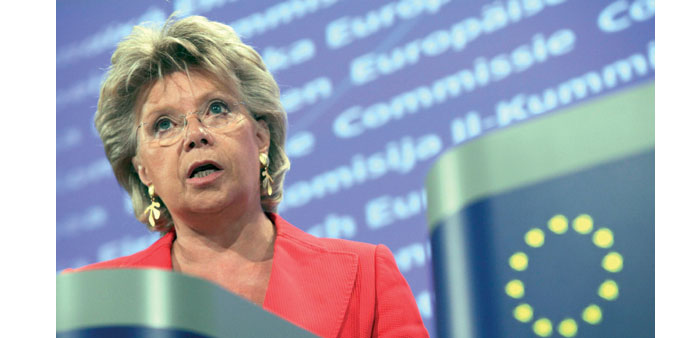
Reding: sympathises with the protesters.