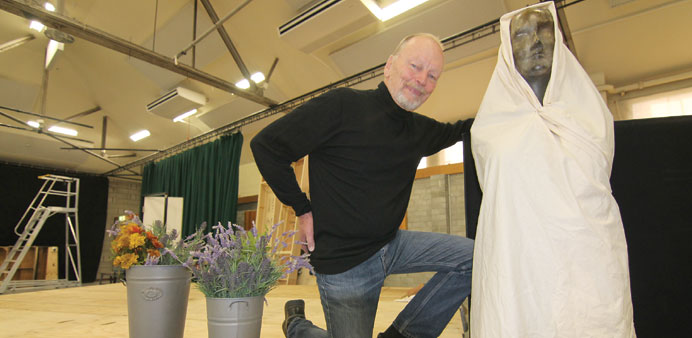
John Bell with props for a production of the opera Tosca at Opera Australia’s rehearsal studios in Surry Hills in Sydney. Shakespearean actor and director Bell has been engaged to direct the upcoming Tosca by Puccini to be staged at the Sydney Opera House.
By Sid Astbury
More than 2mn Australians have seen a Bell Shakespeare production of one of English playwright William Shakespeare’s shows. Many will have seen company founder John Bell acting or directing.
For 50 years, the world’s greatest writer, who died in 1616, has been his grand passion. “I’d love to meet him,” Bell said. “I’d be fascinated. I might be disappointed, but I’d still like to take a punt on it.”
Bell, 72, would have something in common with the writer from 400 years ago. Both he and William Shakespeare were born to middle-class Catholic families in rural backwaters. Both had to suck up to patrons and master the money side of bringing theatre to the people. “There’s one big difference: I can’t write — not like Shakespeare anyway,” he said.
They would have much to talk about. Bell married, had children and lived for five years in Stratford-on-Avon, the bard’s birthplace. He was there with the Royal Shakespeare Company and came home to Australia determined to do things differently.
“You can dress up and pretend to be Elizabethan, but we’re not,” he said.
“Every culture has to appropriate the classics and make them their own. It doesn’t mean desecrating them or being destructive but a certain amount of irreverence, playfulness, is necessary to bring them back to life.”
Bell Shakespeare, which he set up in 1990, is happy with Australian accents and puts on productions in modern dress. There is a bit of tinkering with the language but essentially Bell sticks to the texts. “It’s a conscious decision to bring it into focus for our own times and our own audience,” he said. “Otherwise it’s behind glass. Just an artifact. It can’t really speak to you. If you take too solemn or sombre or too academic an approach, you won’t touch your audience.”
Bell has been spellbound by the bard since his schooldays. His English teacher predicted a career on the stage. And that is the way it has been.
Bell has never had a job outside the theatre. Seemingly effortlessly, he has shifted through acting, to directing to running his own Shakespeare theatre and gaining national and then international recognition. “It’s not luck,” he insisted. “Certain things can work out and then luck may happen. But you can’t wait for luck to come to you.”
He puts his good fortune down to his affinity with William Shakespeare. “Shakespeare seems to be timeless, for all cultures, for all languages,” he said. “He spoke to me — I wasn’t clever enough to go looking for him — he came to me.”
Bell, who has written about Shakespeare, is conscious of the parallels in their lives. “You do take on a certain empathy with a person like Shakespeare. You study his life so much, get to love his work, study his background.”
Bell revisits Stratford-on-Avon to walk the same streets, pass the same buildings, watch the same river flow through the old Midlands market town. Some scholars, some interpreters, take pains to keep separate their musings on the private life of an artist from their estimation of the published work. They think their critical faculties will be infected if they get too personally involved.
Bell is of the opposing school, holding that the life and the work are interwoven. “Shakespeare is an enigma but the more you can get inside his mind, and his life and times, the more you feel you can understand his work,” he said. “It may be a fantasy, but you feel you understand it better.”
Shakespeare wrote most of his plays between 1589 and 1613. He died aged 52. Bell maintains that Shakespeare’s genius allowed him to pack a lifetime’s wisdom into what would now be nearer half of a life. His later plays like King Lear and The Winter’s Tale are all about infirmity, immortality and other concerns of old age.
“There’s something very nihilist and existential about his tragedies,” Bell said. “They’re certainly not Christian statements.
“But, again, it’s guesswork. He may have been feeding into the fashion of the time, playing to an audience.”
At Bell Shakespeare, what plays to a modern audience is a theme like gender politics or racism. But there is also fun, irreverence, even slapstick.
Said Bell: “You have to approach it as actors, as performers, as clowns, to relight the flame. We’re making something theatrical, not a documentary. As long as we speak it and make it comprehensible, Shakespeare’s language stays alive.” — DPA