


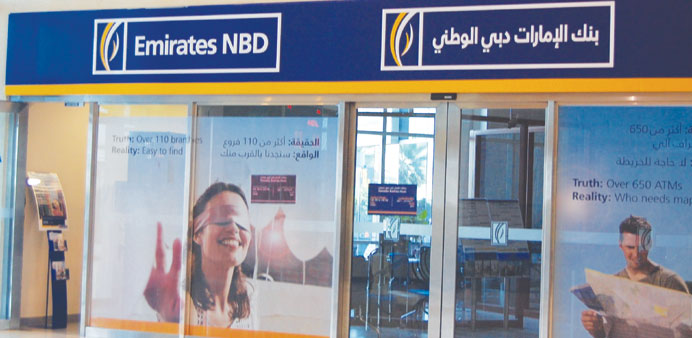
Dubai’s biggest bank Emirates NBD beat expectations with a 50% surge in net profit in the second-quarter, adding to signs the emirate’s economy is recovering robustly and driving its shares higher.
ENBD, 55.6% owned by state fund Investment Corp of Dubai, made a net profit of 972mn dirhams ($264.6mn) in the three months to June 30, compared with 647mn dirhams in 2012, a statement from the bank said.
Analysts polled by Reuters had forecast a net profit of 783.8mn dirhams and shares jumped 7.9% in response, taking gains so far this year in a wider market rally in Dubai to 82.5%.
“Overall we believe that the bank posted an amazing set of results and is very likely to prompt us to revise our full-year estimates on the bank significantly upwards,” Naveed Ahmed of Global Investment House said in a note.
Investor sentiment towards the emirate’s economy has recovered since it was pummelled by a sovereign-linked debt crisis and the bursting of a local real estate bubble in 2009.
Local banks suffered from slower growth and higher provisioning as a result and ENBD, by far the emirate’s biggest bank, received 12.6bn dirhams as part of a 70bn dirham UAE government support package for the banking sector.
It said yesterday it had now repaid 7.8bn dirhams of that money, up from 3bn in April.
One important improvement in the bank’s performance in the past year was a levelling off of previously soaring provisions for bad loans. Those rose by 43mn dirhams to 997mn dirhams in the second quarter compared to the same period of 2012.
That slight rise, however, was offset by the 17% year-on-year rise in both net interest and non-interest income in the second quarter, aided respectively by higher loan and deposit spreads and increased fee income.
ENBD sold part of its stake in Union Properties during the first half of the year but didn’t provide details of the transaction, except to say the shares it still holds are now valued lower than before.
It remains the developer’s largest shareholder with 31.4% of the firm, according to Dubai bourse data.
In May, it raised $1bn from a capital-boosting bond. This helped increase its Tier 1 capital ratio - a key measure of financial strength - to 14.5% at the end of June, from 13.5% at the end of March, well above targets brought in by the Basel banking reform.
The IMF gave an upbeat assessment of improvements in the UAE’s finances last month, although it warned that there were still risks of another boom and bust cycle in Dubai, where growth topped 5% at the end of last year.
Blom Bank
Lebanon’s Blom Bank reported first-half net profit of $175.84mn yesterday, a 6.4% increase on the same period last year, despite what it described as challenging operating conditions in Lebanon and the Middle East.
Assets rose 6.1% to $25.27bn and deposits grew 5.7% to $22.06bn, the bank said in a statement.
Aramex
Dubai logistics firm Aramex reported a 12% rise in second-quarter net profit yesterday, boosted by growth in core Gulf and African markets.
Aramex posted a second-quarter net profit of 72.3mn dirhams ($19.7mn) compared with 64.6mn dirhams in the corresponding period of 2012.
The result was in line with market expectations; four analysts polled by Reuters had estimated on average a second-quarter net profit of 72.1mn dirhams.
Revenue for the quarter rose to 845mn dirhams, up 9% from 777mn dirhams in the prior-year period.
Aramex, a favourite of regional fund managers, has been expanding in the Middle East and Africa and bought South Africa’s Berco Express as well as Kenya’s Oneworld Courier and In-Time Couriers last year.
The company said it would accelerate plans for expansion in Africa and central Asia and aimed to finalise a number of new acquisitions and franchises before the end of 2013.
Saudi Telecom
Saudi Telecom Co (STC) has begun steps to sell its Indonesian business, banking sources said yesterday, as the state-owned firm posted a 41% drop in second-quarter profit.
Saudi Telecom has invested heavily in its Indonesian unit but competitive pressure has dragged on earnings. Indonesia has 10 operators vying for mobile phone subscribers, making it one of the most competitive markets in Asia after India.
Saudi Arabia’s biggest telecoms operator took a non-cash charge of 1.1bn riyals ($293.30mn) in the quarter to write down the value of its investments in Indonesia’s Axis Telekom and Indian mobile phone operator Aircel.
STC has moved its 84% majority stake in Axis to a “held for sale” category, it said in a statement late on Sunday.
A sale process for Axis was ongoing, two banking sources said yesterday, adding that the business may generate interest among existing operators in the country.
The sources spoke on condition of anonymity as the matter was not publicly disclosed.
“We are looking into rationalisation of STC’s international portfolio,” said STC Group chairman Abdulaziz el-Sugair. “Management is evaluating options for some of these investments in order to take appropriate actions in the best interest of the shareholders.”
Profit for the second quarter dropped to 1.4bn riyals ($373.29mn) from 2.4bn in the same period last year.
Annual profits at STC have fallen 43% from their 2006 peak. The company, with operations spanning much of the Muslim world, has spent billions of dollars to buy foreign assets, but competitive pressures closer to home may force it to focus more on the domestic business.
The Saudi market still accounts for about two thirds of STC’s sales and opened up to other players including Etisalat affiliate Mobily in 2005 and Zain Saudi in 2008.
Unrealised foreign exchange losses for the quarter were 505mn riyals due to sharp depreciations of the Turkish Lira, Indian rupee and Indonesian Rupiah, STC said.