


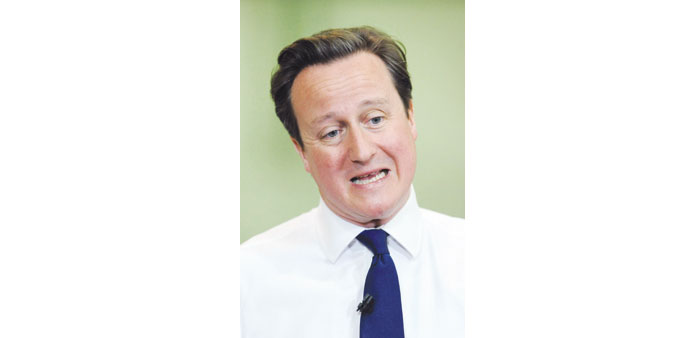
Reuters/London
The economic benefits of Britain’s European Union membership outweigh the loss of independence on policy, the government said yesterday in a review that will underpin Prime Minister David Cameron’s plan to renegotiate EU ties and hold a referendum.
Cameron rattled many business leaders, EU members and wider trading partners in January when he promised to claw back powers from Brussels and hold a vote by 2017 on whether to stay inside the 28-nation bloc or leave.
His flagship policy has raised the prospect of Britain leaving its main trading partner after 40 turbulent years marked by arguments about the nature of London’s relationship with its European neighbours.
France and Germany have signalled they want to keep Britain in but will resist “cherry-picking” EU policies, while US President Barack Obama suggested Britain should try to fix its relationship rather than walk away.
Before the start of renegotiation, Cameron ordered a review of how the EU affects British life across 32 areas, from health and education to the economy, tax and immigration.
The first six reports were published yesterday, looking at areas including the single market, taxation and foreign policy.
Access to a market of 500mn people means Britain’s gross domestic product is “appreciably greater” than it would otherwise have been, the review found.
However, it noted the opposition to EU regulation and “constraints on policy-making”.
The document offered no figure for the gain in economic output due to the single market but it cited six other studies, five of which said membership was worth up to 6.5% in extra GDP.
The sixth said GDP was 3% lower due to the EU.
“Is that trade-off, between cost and benefit, between economics and politics, of overall benefit to the UK? It is not possible to give a simple, unambiguous, and universally accepted response,” the review said. “But most observers, and indeed most of the evidence received for this report, answer positively.”
The government has described the review as “the most extensive analysis of the impact of EU membership on the UK ever undertaken”. It aims to present the views on both sides of the “in/out” argument, rather than reach a verdict on Britain’s membership.
Critics say it fuels a perception of Britain as an awkward, semi-detached partner, prone to weighing its ties with Brussels in terms of costs and benefits rather than committing fully to a unification project born out of the ashes of World War II.