


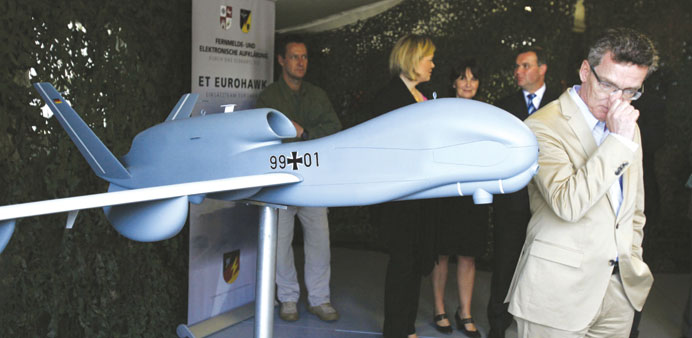
This July 12, 2011 photo shows German Defence Minister Thomas de Maiziere next to a model of the ‘EuroHawk’ unmanned aerial vehicle (UAV) during his visit to the Joint Support Service base in Grafschaft, near the western German city of Bonn.
DPA/Berlin
Germany’s parliament has launched hearings into the defence ministry’s botched procurement of reconnaissance drones, in a scandal that threatens to damage Chancellor Angela Merkel’s government two months before national elections are held.
Defence Minister Thomas de Maiziere has rebuffed calls to resign after the collapse of a project to outfit US-made Global Hawk drones with sophisticated German sensors for aerial surveillance.
He has blamed his predecessors and subordinates.
Germany signed a contract in January 2007 to develop the “Eurohawk” version of the pilotless craft, which is as big as an executive jet. After 500bn euros of taxpayer money were spent, the order was cancelled.
The committee of inquiry has been instructed to report by August 31 on what went wrong. Germany goes to the polls on September 22.
The inquiry aims to establish the cost of the fiasco, why defence employees did not tell their minister about its problems and whether de Maiziere, the minister since 2011 and who is set to testify on July 31, acted quickly enough after learning the project was stillborn.
On the hearing’s first day, Wolfgang Schneiderhan, the chief of staff for the German armed forces from 2002-09, testified that the military was aware of the “technological leap” needed to make the drones airworthy but pushed forward anyway “since we all agreed the army needs this ability”.
Two former defence ministers, Rudolf Scharping and Franz Josef Jung, were grilled over the project yesterday.
As the election nears, opposition parties have focused on the fiasco to argue that the Merkel government is incompetent.
The Eurohawk version made its maiden flight in 2010, but officials realised the drone lacked the modifications and documentation required if European aviation-safety authorities were to certify it as airworthy for Europe’s crowded airspace.