


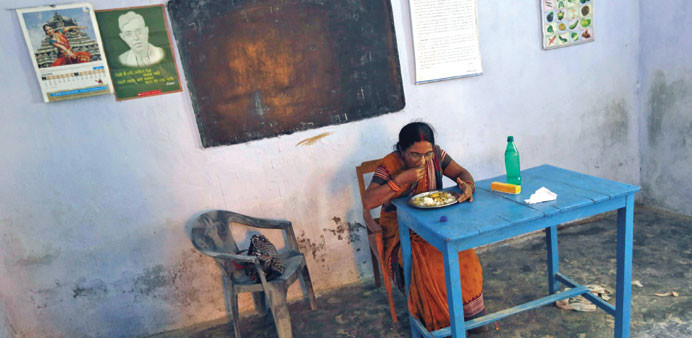
Srimati Kumari, a school headmistress, eats the free mid-day meal, distributed by a government-run primary school, before being served to schoolchildren at Brahimpur village in Chapra district, Bihar, yesterday.
Reuters/New Delhi
The village school in Bihar where 23 children died by poisoning last week had been providing lunch under a government-sponsored scheme without checks or monitoring by local officials to see if the food was stored carefully or cooked properly.
Although it is the first such disaster in the “midday meal” project that feeds about 120mn children every day across India, a Reuters review of audit reports and research papers shows officials have long ignored warnings of the lack of oversight and accountability in the programme.
“You only come and do checks when you get complaints or when there are serious cases,” said Rudranarayan Ram, the local education administrator for the village of Gandaman in Bihar, where the children died. “This was the first time.”
The poisoning, which police suspect was caused by storing cooking oil in a used pesticide container, killed the children so quickly that some died in their parents’ arms while being taken to hospital.
Ram, who was tasked with monitoring the programme, said the headmistress of the school, who has fled, bought the food and the oil in which it was cooked. He just doesn’t know from where nor how the items were stored.
Although fatal contamination is extremely rare in the midday meal scheme, auditors in several states have described unhygienic conditions in which the food under the programme is prepared and served, and the poor quality of food itself. Two audit reports by the state governments of Andhra Pradesh and Madhya Pradesh have said the food in the scheme was often laced with stones and worms.
Another survey by the Indian Institute of Management noted children in Gujarat were made to wash up after their meals by “rubbing the playground soil on the plates and then giving a quick rinse”.
“If the government checks, they will find that the children who have been eating midday meals are under great physical threat,” said Ajay Kumar Jha, professor at A N Sinha Institute of Social Studies, who led a team to monitor the programme in Bihar in April.
The midday meal scheme of giving school pupils a free lunch is the largest such programme in the world. It has been widely lauded as one of the most successful welfare measures in India because it also boosts school enrolments and helps children to continue studies.
For millions of poor families, the lunch is the only full meal their children eat in a day. That encourages them to send them to school, and not keep them home to help with chores.
Still, audit reports have highlighted the continuing failings of the programme, more than a decade after feeding children a cooked meal in schools was mandated by a Supreme Court order.
The problems include grain kept in decrepit condition in federal warehouses, and then often stored and cooked in poorly-equipped schools by staff with little or no training.
P K Shahi, the education minister in Bihar, said there were no warnings from the federal government about the programme.
“There were general advisories for better hygiene. That’s all,” he said.