


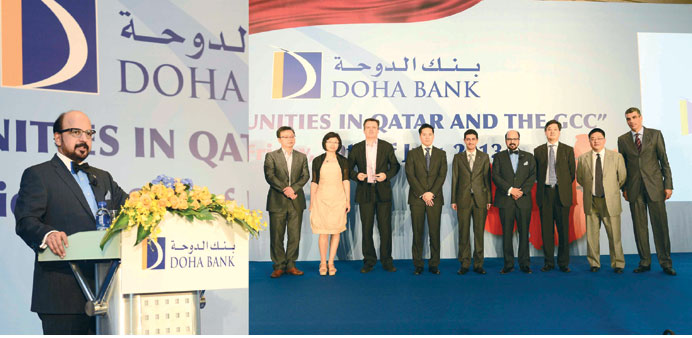
Doha Bank hosted a knowledge sharing session on “Opportunities in Qatar and the GCC” in Shanghai on Friday.
Hassan M al-Khater, deputy head of mission at the Embassy of Qatar in Beijing, was present at the event, which was attended by bankers, economists and key industry professionals.
Speaking on the occasion, Doha Bank Group CEO Dr R Seetharaman highlighted bilateral developments between Qatar and China. “Qatar-China bilateral trade touched $8.45bn in 2012. In June 2010, the Qatar Investment Authority invested $2.8bn in the IPO of Agricultural Bank of China and further raised its stake to $6bn. In March 2011, Qatar signed an $879mn contract with China Harbour Engineering Co for the construction of the first phase of Qatar’s New Doha Port,” he said.
“In January 2012, China National Petroleum Corp and its partners, Qatar Petroleum and Royal Dutch Shell, agreed to push ahead with plans for a $12.6bn refinery and petrochemical complex in east China. In May 2012, PetroChina, Asia’s largest oil and gas producer, signed an agreement to acquire 40% of exploration and production rights for Qatar’s Block 4 from GDF Suez Qatar. In August 2012, Qatar’s sovereign fund bought a 22% stake in China’s CITIC Capital. China is planning to import more LNG in coming years in order to meet huge demand in its domestic market,” Seetharaman said.
Highlighting the bilateral trade between the Gulf Co-operation Council and China, he said: “GCC-China trade was at $92.5bn in 2010 and reached $155bn in 2012. Exports from the GCC to China in 2012 were $101bn and imports from China in 2012 were $54bn. Saudi Arabia was the major contributor to GCC trade, followed up by the UAE and Oman. Trade between China and Saudi Arabia reached the highest level of $73.4bn in 2012. The UAE is China’s largest export market in the Gulf; bilateral trade between the two countries reached more than $40bn in 2012. With bilateral trade expanding, the GCC can expect to increase the usage of yuan.”
Seetharaman also gave insights into major bilateral developments between the GCC and China. “Aramco and Sinopec signed a deal to develop a 400,000 bpd refinery, Yasref, in January 2013. The Chinese bought properties worth nearly 550mn UAE dirhams in 2010, while China and the UAE signed a $5.5bn currency swap deal in January 2012,” he said.
GCC projects worth more than $350bn are expected to be launched in 2013, he said. “The Chinese can further invest in the UAE’s infrastructure construction projects of transportation, telecommunication and electricity. The Kuwait Investment Authority and the Qatar Holding are qualified foreign institutional investors in China. GCC-China bilateral trade and development are witnessing an upward trend,” he said.
Seetharaman also gave insights on the global economy. “IMF’s World Economic Outlook update, July 2013, has forecast that the global economy will grow by 3.1% in 2013. Growth has been revised marginally downwards in 2013 in developed economies such as the US and the euro region. US economic growth has been brought down by the International Monetary Fund to 1.7% for 2013. However, growth has been revised upwards by the IMF for Japan and UK to 2% and 0.9%, respectively, for 2013. Emerging economies’ growth has been brought down to 5% from the earlier forecast of 5.3% for 2013,” he said.