


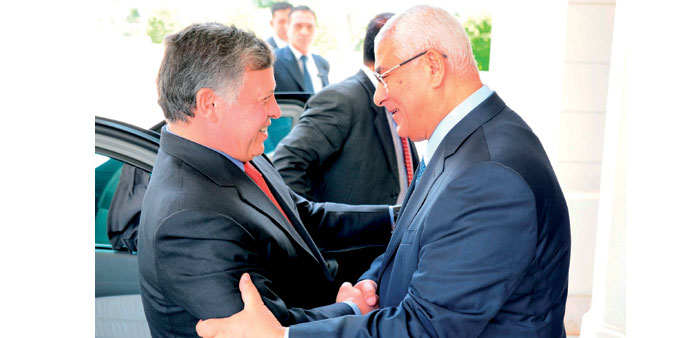
Egyptian interim president Adly Mansour welcomes Jordanian King Abdullah II in Cairo yesterday.
AFP/Cairo
Jordan’s king met Egypt’s interim leaders yesterday, the first head of state to visit since the army ousted its Islamist president, as a panel was appointed to amend the constitution.
The caretaker government sworn in this week has had its work cut out, with tensions running high amid protests by supporters of Mohamed Mursi calling for his return and deadly clashes on Friday night.
King Abdullah II of Jordan, who himself faces challenges at home from Islamists, was among the first leaders to congratulate Egyptians after Mursi was overthrown by the military on July 3.
The monarch was greeted at Cairo airport by the army-backed interim prime minister Hazem al-Beblawi, and held talks with president Adly Mansour and vice president Mohamed ElBaradei.
King Abdullah pledged his support “for Egyptian national choices”, a presidential statement said, with the two leaders agreeing to boost ties.
His visit came as the newly installed regime launched a campaign to burnish its credibility, and as the interim president set the constitutional reform process in motion.
Mansour appointed a committee of four university professors and six judges to draft the amendments to the Islamist-drafted constitution adopted under Mursi’s presidency within 30 days.
The panel’s amendments will be presented to a 50-strong body representing different groups in Egyptian society, which will submit final improvements to the president.
He will then have 30 days to call a referendum on the new charter. But Mursi’s supporters have rejected the legitimacy of the interim authorities.
Thousands of them pressed ahead with a sit-in at Cairo’s Rabaa al-Adawiya mosque yesterday, where they have vowed to stay until their president is reinstated.
The Islamists rallied in their tens of thousands on Friday, waving Egyptian flags, carrying portraits of the toppled Islamist leader and denouncing Abdel Fattah al-Sisi, the army chief behind the coup.
Despite warnings by the military, some protests turned violent, with three people killed in the Nile Delta city of Mansura.
Egypt’s new foreign minister, Nabil Fahmy, said yesterday that he would prioritise “defending the revolution abroad”.
The ministry would “form a committee to follow what is published about the revolution abroad and to provide sound information”, Fahmy told a news conference.
Egypt also sent an envoy to African states to convince them that Mursi had been removed by a popular revolution, he added.
The foreign minister sounded a more cautious note in dealing with the Syrian crisis, saying Mursi’s decision to cut diplomatic ties with the war-torn country would be “re-examined”.
Fahmy is due to meet the new leader of Syria’s main opposition coalition, Ahmed al-Assi, today.
“There is no intention of jihad in Syria,” the former Egyptian ambassador to Washington said, in reference to calls for a holy war in Syria under Mursi’s presidency.