


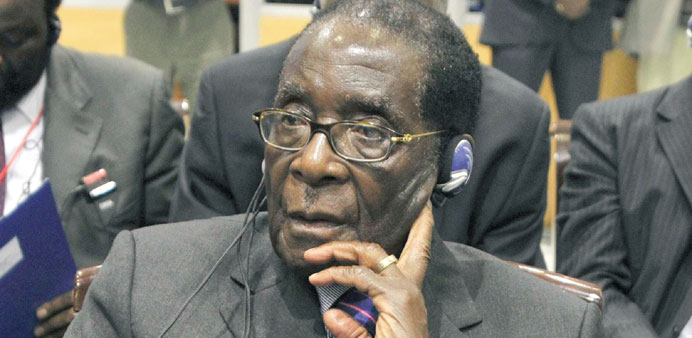
Mugabe: only Zuma can talk.
AFP/Harare
Zimbabwe President Robert Mugabe has warned South Africa’s Jacob Zuma to stop his top mediator from commenting on the country’s political crisis, as the veteran leader stepped up electioneering.
“That persistent negative voice from South Africa, could it be stopped,” Mugabe told thousands of supporters at a campaign rally in the Matabeleland region.
“I appeal to President Zuma to stop this woman of theirs from speaking on Zimbabwe,” said Mugabe referring to Zuma’s adviser, Lindiwe Zulu.
It was Mugabe’s second attack on Zuma’s envoy. Earlier this month he called Zulu a “streetwoman” when he kicked off his election campaign.
Mugabe, who is running for re-election in the July 31 vote, said that only Zuma had a right to speak on Zimbabwe.
“We were given one facilitator, that’s President Zuma and only his voice should speak,” he said. “No other voices.”
Zuma is leading the Southern African Development Community (SADC) mediation team on Zimbabwe, which pushed for the crunch vote.
The regional bloc had pressed Mugabe to allow time for a series of reforms that would limit the military’s role in politics and strip ghost voters from the electoral roll.
Mugabe’s renewed attack on Zulu comes as the SADC peace and security organ is meeting in Pretoria to discuss the country’s political crisis.
The 15-member block brokered the power-sharing deal between Mugabe and Tsvangirai in 2009, a year after around 200 opposition members were killed in election-related violence.
But there is no love lost between Mugabe and the SADC at the moment.
He threatened to leave the bloc if it meddled in Zimbabwean affairs and scolded South Africa’s top diplomat “stupid and idiotic” in an election rally earlier July.
“As we go to elections, we expect our friends from the Southern African Development Community, the African Union and COMESA (Common Market for Eastern and Southern Africa) to assist us in this process by encouraging us, and where they are able to do so by materially helping us to fund the elections,” Mugabe said.
The veteran leader urged the neighbouring countries to refrain from making unfavourable comments.
“We don’t expect SADC countries to be spreading lies about us and telling others that the situation in Zimbabwe is not peaceful, that the ground is not even.”
On Friday, Zulu said there were still challenges in the run-up to the key polls aimed at ending the uneasy unity rule between Mugabe and his archrival Prime Minister Morgan Tsvangirai.
“The process has got challenges, we can’t deny that because we’ve seen what info has been coming out during the special vote,” said Zulu.
During early voting on Sunday and Monday polling stations opened late and many lacked indelible ink, stamps, voter rolls and ballot papers and boxes.
“If things didn’t go right in the special vote, those things need to be looked into by the time of elections on July 31,” Zulu had said.
With the vote due in less than two weeks, Zimbabwe is still trying to raise the $132mn budget required to fund it.
“We are doing everything we can to make sure that we have the sufficient resources to fund the elections,” Finance Minister Tendai Biti told journalists on Friday.
“I am very positive that we will get the money,” admitting that “we do not have the resources at the present moment”.
Biti, who is a member of Tsvangirai’s party, had previously declared that the country had no money to fund the crucial elections, and launching an international appeal for finance.
In April, the cash-strapped country withdrew its funding appeal to the United Nations.
Early this year the government had to borrow money from local firms to pay for the referendum on a new constitution.
“We are getting no joy from diamond monies. Over $400mn have been sold of diamonds just in the first quarter of the year, (but) nothing has come to treasury,” said Biti.
Meanwhile, Tsvangirai addressed a rally in the second city of Bulawayo, warning that returning Mugabe to power would be a backward move.
The African Union had said after its Peace and Security Council meeting on Friday that it was possible to have fair elections.
“According to our observers on the ground we believe that it is possible to have free and fair elections in Zimbabwe,” said Aisha Abdullahi, AU commissioner for political affairs on Zimbabwe.
“But we cannot guarantee that it will be the most perfect or optimum of situations,” he said after an AU peace and security council meeting.
“The environment in Zimbabwe so far reassures us that the conditions are good for the election to be held on July 31,” he said.
Mugabe called early polls, hoping to prolong his 33 years in power, despite demands for reform by Tsvangirai.