


By Alexander Welscher
For more than 200 years, the palace of the erstwhile grand princes of Lithuania was missing from the cityscape of the capital Vilnius. For most of that time it would have seemed ridiculous to imagine the palace ever being rebuilt.
But at turn of the millenium 13 years ago, Lithuania came to a decision to reconstruct, down to the smallest detail, the historic residence of the rulers. Now the palace has opened its doors to the public — just in time for Lithuania’s six-month term as president of the European Union.
“Every nation wants and needs symbols that are a visible expression of their state sovereignty and national dignity,” says Vydas Dolinskas, director of the National Museum in the Palace of the Grand Princes.
“With this reconstruction we want to tie into the historical heritage and the cultural importance of the building for Lithuania,” he added.
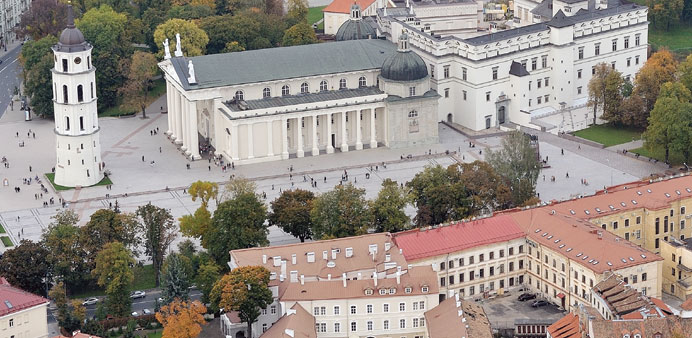
Four storey tall, the palace took more than a decade to build, but will now again become the focal point of an extensive complex in the heart of Vilnius, a complex that includes the cathedral, the fortress of Gediminas and the two former arsenals.
At first only the southern wing has been opened, housing the museum. Later on, other sections of the 14,000 sq m complex will be opened to provide a cultural-historical centre and a number of halls for concerts and events.
In the 13th century it was Lithuanian King Mindaugas who resided in the palace, followed for nearly three more centuries by grand princes. In some cases, the grand princes were at the same time the kings of Poland. The Polish-Lithuanian empire stretched from the Baltic Sea in the north to the Black Sea some 1,000km to the south.
But with the political demise of the Polish-Lithuanian empire, the palace also lost its glamour. In 1801, the entire palace was stripped all the way down to its foundation walls and the materials carried off.
Now, however, the erstwhile seat of power is standing again. The idea for the reconstruction evolved at the same time as the idea of Lithuania’s independence movement in 1987. At the time the Baltic state was still a part of the Soviet Union. Thirteen years later, with the country now free and independent, the Lithuanian parliament voted to rebuild the palace.
At the same time that surveys showed 80% of Lithuanians supporting the reconstruction, there were, however, sceptics who warned against romanticising the country’s nationalistic past.
Architectural experts, for their part, pointed out that there were only very sketchy records of how the rooms of the palace were actually outfitted — so much for the quest to rebuild down to the last detail.
The biggest point of criticism concerns the costs. Currently the total cost of construction is projected at a good €100mn ($130mn) — three times what was initially planned, and the bills are still coming in. And the palace was supposed to have been completed in 2009, but this was set back in the wake of the international financial crisis and a temporary construction stop. — DPA