


AFP/Islamabad
Pakistan’s top foreign affairs official will meet the Afghan president in Kabul tomorrow to discuss stalled efforts to begin talks with the Taliban in Qatar, a senior Pakistani official said yesterday.
The visit by Sartaj Aziz comes after Hamid Karzai’s chief of staff claimed the Taliban’s office in the Qatari capital Doha was part of a plot to break up Afghanistan, orchestrated by either Pakistan or the United States.
Pakistan’s support is seen as vital to achieving lasting peace with the Taliban in Afghanistan. But relations between the two neighbours are rocky, with Kabul regularly accusing Islamabad of supporting the militants.
Pakistani Prime Minister Nawaz Sharif kept the foreign affairs portfolio under his own control after winning the May general election, but Aziz, an elder statesman who served as a minister in the 1990s, is effectively the foreign minister.
A senior official said Aziz would pay a day-long visit to Kabul tomorrow to hold talks with Karzai and other top Afghans.
He said the talks “will primarily focus on ways to promote reconciliation in Afghanistan with reference to the Doha
process”.
“We remain supportive of the reconciliation process in Afghanistan and want an Afghan-led and Afghan-owned mechanism to be in place enabling all Afghan groups to decide about their future,” the official said.
When the Taliban opened their office in Doha on June 18, it was hailed as a first step towards a potential peace deal, but a furious Karzai slammed it as an unofficial embassy for a
government-in-exile.
The Taliban said earlier this month that it had temporarily closed the office in Qatar, blaming “broken promises” by the Afghan government and the United States.
Karzai’s chief of staff Karim Khorram claimed on Thursday that “the opening of the Qatar office, the way it happened was a plot and Afghanistan foiled that plot and this plot was aimed at splitting or breaking up Afghanistan”.
Aziz told reporters in Islamabad he hoped a row over the naming of the office and its use of a flag would be resolved.
Analyst and author Imtiaz Gul said Karzai’s rhetoric against Pakistan was an effort by the president to change the perception of him as a US puppet as he prepares to leave office ahead of elections next year.
“This visit basically aims to smoothen the relationship as well as prepare reciprocal visits by Sharif and Karzai,” Gul said.
“Pakistan looks very uncomfortable at the moment with what seems to be an erratic and desperate Karzai.”
CALL TO WIDEN PEACE PROCESS: Pakistan and Afghanistan plan fence-mending talks this weekend, but an Afghan militant faction warned yesterday that a reconciliation process limited to the Taliban and United States was unlikely to stabilise the country, DPA reported.
Pakistan national security and foreign affairs adviser Sartaj Aziz will travel to Kabul tomorrow to discuss the stalled Afghan peace process with President Hamid Karzai, officials said.
But Hezb-e-Islami, the second-largest Afghan militant faction led by Gulbuddin Hekmatyar, said a “narrow” reconciliation process limited to the US and Taliban is unlikely to
stabilise Afghanistan.
A spokesman for the group’s political wing said that the West should look beyond the Taliban to seek an end to the conflict.
“That is the only way forward ... anything less than that is unlikely to fix Afghanistan,” said Ghairat Baheer.
Baheer, who lives in Pakistan like many other Hezb-e-Islami leaders, said his group was approaching other factions to decide whether to accept the outcome of US-Taliban talks.
Diplomatic efforts are under way in Washington, Kabul, Islamabad and Doha to save the talks from collapse, according to Pakistani officials.
Hezb-e-Islami and Afghan warlords are considered important players, but they are not part of the dialogue for peace.
Islamabad has said it favours an all-inclusive approach led by the Afghan administration.
Experts believe Hezb-e-Islami and other factions should not be left out of the process.
Fida Khan, an Islamabad-based analyst, said Hezb-e-Islami would definitely react if it feels that its interests are not taken care of, although it is much smaller than the Taliban.
“To be a spoiler, you don’t need to be big,” said Khan.
But Saad Mohammad, a former brigadier who served as Pakistan’s defence attache in Kabul from 2003-06, said the Taliban strengths might overshadow that of all other groups.
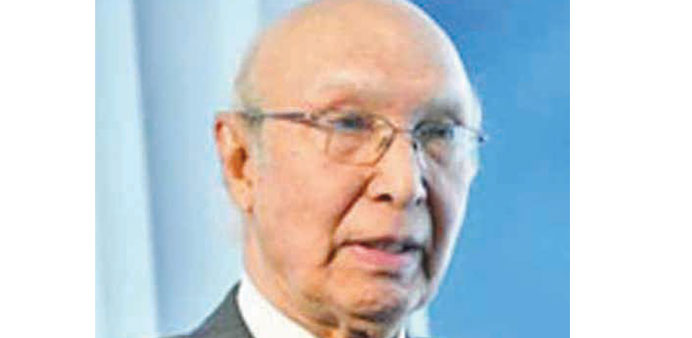
Sartaj Aziz