


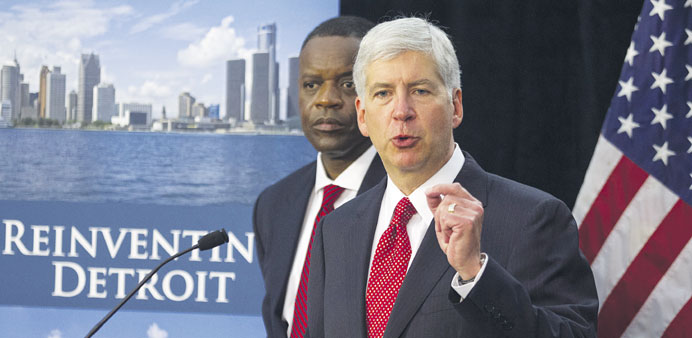
Orr (left) and Michigan Governor Snyder discuss the filing of bankruptcy by the city of Detroit at a news conference yesterday.
AFP/Detroit
Detroit will be a great city again once the birthplace of the US auto industry gets a fresh start with a bankruptcy filing, Michigan’s governor said yesterday.
Saddled with more than $18bn in debt and a shrunken tax base, the Motor City has been so strapped for cash it can’t even keep the streetlights on.
“Now is the opportunity to stop 60 years of decline,” Governor Rick Snyder said at a press conference a day after approving the biggest municipal bankruptcy in US history. “We will come out with a stronger, better Detroit and a format to grow this city.
“The citizens of not just this city but the state deserve it.”
Once a beacon of industrial might, the city is now a poster child for urban decay, its landscape littered with abandoned skyscrapers, factories and homes.
Detroit has seen its population shrink by more than half – from 1.8mn in 1950 to 685,000 today – as crime, flight to the suburbs and the hollowing out of the auto industry ate away at its foundations.
The bankruptcy is expected to make it harder for municipalities in Michigan and other US states to borrow money, by undermining confidence in what used to be among the most trusted bonds available.
Snyder insisted there was no other “viable” option because the city is “broke” with 38% of its budget spent on debt and pension obligations.
The situation in Detroit is being closely monitored by government workers across the country who are fearful that they too may see their retirement benefits slashed by cash-strapped states and cities.
About $9bn of the city’s debt is owed to the pension funds and retiree healthcare benefits of the city’s 10,000 workers and 20,000 retirees.
While pension benefits are protected by the state’s constitution, the federal bankruptcy process could drastically diminish those obligations.
State-appointed emergency manager Kevyn Orr said the city has about $2bn to repay $12bn in “unsecured” debt, which includes the pension obligations.
“Yes, there are 10,000 employees. Yes, there are 20,000 retirees. But there are 700,000 citizens who don’t deserve 58 minute (police) response times,” Orr said. “Does anybody think it’s okay to have 40-year-old trees growing through the roofs of dilapidated houses? Does anybody think our children should walk through the streets in the dark after school?”
The head of the nation’s main public workers union castigated Snyder and Orr for refusing to negotiate an alternative approach.
“Detroit’s public service employees worked hard and played by the rules, and now their freedom to retire with dignity is in peril,” AFSCME president Lee Saunders said in a statement. “Apparently Governor Snyder and Kevyn Orr want Detroit’s public service workers to rely on their children for food and shelter, or have to work until they die.”
The city will continue to function during the bankruptcy process and could even end up paying its bills “quicker than usual”, Orr vowed.
Lifelong resident Milton Walker, 45, said that while it is “unfortunate” that city workers will lose their benefits, bankruptcy was “right thing to do”.
“They can’t pay them if they don’t have it – you can’t get blood out of a turnip,” Walker told AFP.
Rachel Lutz, who owns two boutiques near the Detroit Institute of Art, said that she expects the city will be able to pull through the bankruptcy.
“I’m both a resident and a business owner in Detroit, but I don’t think it’s going to affect me on any intimate level,” she said, as a steady stream of customers perused the clothes in her shop.
It will be up to a federal judge to determine if Detroit is allowed to restructure – and even shed – its obligations in a Chapter 9 bankruptcy.
Unlike General Motors and Chrysler – which were able to restructure under bankruptcy protection in 2009 in a matter of weeks thanks to the backing of the US government – it could take years for Detroit’s case to be resolved.
“One of the biggest challenges is that there haven’t been very many municipal bankruptcies in the history of the bankruptcy code, so there’s not a lot of guidance,” bankruptcy lawyer Douglas Bernstein of Michigan-based Plunkett Cooney told AFP.