


DPA/Fort Meade
The judge in US Army Private Bradley Manning’s court martial has refused to dismiss the most serious charge against the admitted intelligence leaker.
The decision by Colonel Denise Lind means that Manning, if found guilty of the charge that he aided the enemy, could be sentenced to life in prison.
Lind also refused a defence request to drop a charge that Manning had committed computer fraud by stealing government documents.
On the charge of aiding the enemy, defence lawyer David Coombs argued that Manning “had no actual knowledge if the enemy used WikiLeaks”.
Manning, 25, has admitted to releasing 700,000 secret military and diplomatic documents to the anti-secrecy website WikiLeaks. He has been held in prison since his arrest in 2010.
Lind ruled that the prosecution had, at the least, offered some evidence for both of the charges, saying the question of whether it was credible played no role in her decision.
The judge said that, as an intelligence analyst in Iraq, Manning had received training that identified Al Qaeda as a terrorist group and knew that the enemy uses the Internet.
“The accused has been advised that the release of classified information could damage the US,” Lind said.
Lind’s ruling keeps the Manning trial on track to create a precedent for the government’s prosecution of other leak cases, such as that of Edward Snowden, civil rights and press freedom advocates said.
Snowden last month divulged the massive surveillance programmes of the National Security Agency (NSA) and has applied for temporary asylum in Russia to avoid US espionage charges.
Revelations by either Snowden or Manning or both have been published in various newspapers, including the Washington Post, the New York Times and Britain’s Guardian.
“What’s surprising is that the prosecutors in this case, who have a duty to act in the interest of justice, have pushed a theory that making information available on the Internet – whether through WikiLeaks, in a personal blog posting, or on the website of the New York Times – can amount to ‘aiding the enemy’,” Widney Brown of Amnesty International said.
To prove Manning aided the enemy, prosecutors have to show that he knew the information he sent to WikiLeaks would be seen by Al Qaeda.
Coombs had argued Manning “had no actual knowledge if the enemy used WikiLeaks”.
In his request to drop the two charges, Coombs had also said the prosecution could not prove that Manning had “general evil intent” – one of the requirements of proving he aided the enemy.
Coombs referred to a US Army publication drafted in 2008, which stated that, at the time, the US Army did not know whether Al Qaeda read the WikiLeaks website.
Manning had access to documents about the wars in Iraq and Afghanistan and said he wanted to spark debate about US military actions in those wars.
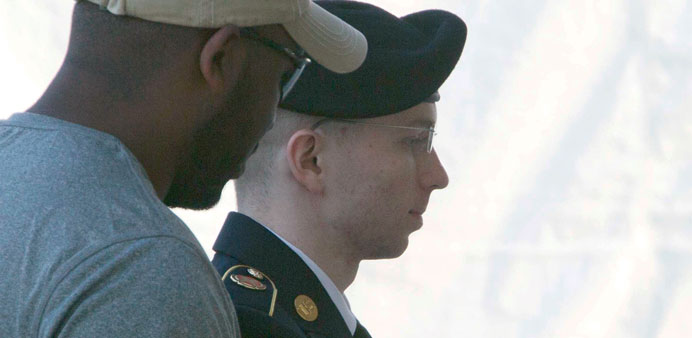
Manning