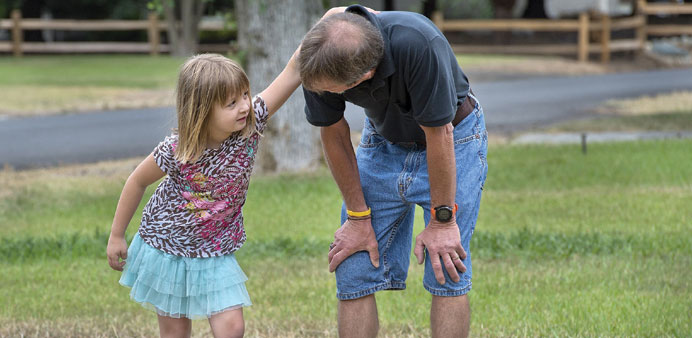
David Schooley and his daughter Hannah break after tossing a football in Sacramento, California. Almost two years after David went to his primary care doctor complaining of forgetfulness and confusion, he was finally diagnosed with Alzheimer’s disease just before Thanksgiving 2012.
By Anita Creamer
Claire Schooley tried for several years to get doctors to diagnose what was going on with her husband, David, now 57.
He would ask her the same questions again and again, never remembering the answers. He would grow confused. Two years ago, on a trip to San Jose with their kids, now ages 6 and 12, he drove 60 miles in the wrong direction from their hotel, insisting the whole time he knew where he was going.
Maybe his memory loss was the result of depression over two job losses, most recently in 2009, doctors told the Sacramento couple. Maybe it was stress.
He was growing silent and distant, increasingly lost in his own world.
“I’d see him sitting in front of the TV at home,” said Claire Schooley, 45, a network engineer. “He’d say he was taking a break, but he’d forgotten what he was doing or what room he was in.
“He never was like this before. We were having a tough time. I knew in my heart there was something wrong.”
Two days before Thanksgiving 2012 – and almost two years after he sought help from his primary care physician – David Schooley finally was diagnosed with Alzheimer’s disease. For people with the degenerative brain disease, delays in diagnosis can exact a steep cost.
Without timely diagnosis, people with Alzheimer’s lose valuable months when medications can most effectively slow their memory loss. The delay in diagnosis robs families of the chance to enjoy their time together and make financial and legal plans for the future.
Alzheimer’s is now the US’sixth-leading cause of death, with 5.4mn people affected. Even so, physicians can be slow to identify the disease in the elderly, despite the fact that old age is the greatest risk factor. And doctors can be even more reluctant to diagnose people below the age of 65 who suffer from the rare, early-onset form of the illness.
“Honestly, it’s a routine thing that families in general try to get the person seen by a knowledgeable physician for more than a year, even a couple of years,” said neurologist Dr Charles DeCarli, director of the UC Davis Alzheimer’s Disease Center.
The US Centers for Disease Control and Prevention estimates that only 4% of Americans with the disease are younger than 65. But with the ageing of the baby boom generation — and the coming Alzheimer’s epidemic, projected at 14mn cases by 2050 — the hard numbers behind that younger-onset percentage continue to rise.
Typically, experts say, families end up frustrated in seeking help, because primary care physicians aren’t looking for dementia in people still in the prime of life. “Many providers find it hard to believe that someone so young could have dementia or Alzheimer’s,” said Elizabeth Edgerly, the Alzheimer’s Association of Northern California’s chief programme officer.
“It’s really difficult. People in their 50s are misdiagnosed with bipolar disorder or depression or even midlife crisis. Or they’re told, ‘Of course, you have memory problems. Who doesn’t?’”
When Bev O’Neil noticed that her friend and employer, Karen Cozakas, was asking the same questions over and over, she thought the memory loss might be related to menopause.
“We didn’t know,” O’Neil said.
Cozakas, now 60, a former technology executive who lives outside Placerville, was a competent, upbeat and organised woman. Then the bank began calling to report bounced cheques: Karen, it turned out, could no longer balance her chequebook.
“It seemed everything was going fine, and all of a sudden, everything seemed to shift,” said Cozakas. “It came on me so fast. Well, to me, it seemed fast. It seemed funny. I forgot little things here and there, but the little things got bigger and bigger.
“And all of a sudden, we were in a bigger place.”
Doctors diagnosed her, at age 56, with mild cognitive impairment — memory loss that in an estimated one-quarter of patients leads to Alzheimer’s — but prescribed none of the drugs that can delay the progression of forgetfulness.
A few months later, she was diagnosed with Alzheimer’s. Now she’s on two medications and participates in a clinical trial through the UC Davis Alzheimer’s Disease Center. And O’Neil, her longtime friend, is her caregiver.
“We’re better off knowing than not,” said her husband, Michael Cozakas, 61. “You need to know and react accordingly. I think denial is worse than the disease. If you deny, you expect things to change. They don’t. They get worse.
“If you don’t have a fixed baseline of understanding, you’re constantly upset and frustrated.”
For many patients, diagnosis is delayed because a comprehensive assessment of dementia requires a detailed clinical history and neurological exam, said DeCarli. The process takes an hour, and most primary care physicians, who can see up to 40 patients a day in their practices, don’t have the time.
“It’s a challenge for primary care physicians,” he said. “I tend to see them adapting a number of strategies. When someone has memory complaints, they get a brain scan and get the patient on memory-enhancing drugs.
“The other strategy is to minimise the complaint until the situation gets more severe.”
Complicating the picture is the fact that dementia has other causes beyond Alzheimer’s: Pain medications, vitamin B12 deficiency, thyroid conditions, chemotherapy and some infections also can cause memory loss. So can diabetes and vascular problems.
The average person with dementia comes into contact with the healthcare system four times more frequently than patients without dementia, said DeCarli.
Beyond the health consequences and frustration, families of people with early onset Alzheimer’s also deal with the fact that delayed diagnosis forestalls the process of applying for Social Security disability payments.
And, said the Alzheimer’s Association’s Edgerly: “The travesty of not getting diagnosed is that people are alone. They’re alone, and they have no idea what’s going on. It’s very sad.”
After long delays finally gave way to a referral to a neurologist, Claire Schooley hoped for a diagnosis for her husband. By that time, she suspected he might have Alzheimer’s.
But she wanted to know. For him, for their children, for their future, she wanted to be able to plan.
“The neurologist went over the test results and said, ‘You can come back in a year,’” said Schooley. “I was really scared it was Alzheimer’s, but after the referral, I thought they’d help us.
“I started crying. I was really upset. I said, ‘I’m telling you, there’s something wrong with him.’”
She insisted on a follow-up test, a positron emission tomography (PET) scan, which showed decreased brain cell activity.
Her husband of 13 years — the former telecom technician who once could fix anything, the man who made the dean’s list when he retrained in HVAC school a half-dozen years ago – definitely had Alzheimer’s. The news came as both a shock and a relief.
“David doesn’t talk much anymore,” said Schooley. “He’s forgotten about things he can’t do. I’m worried about my kids. My son asks, ‘Is he going to forget who I am?’ Chances are, he will. “But we’re trying to make memories for our kids, so later that’s the part they’ll remember.’” — The Sacramento Bee/MCT
Study links heavy
cell phone use with
poor fitness levels
By Cheryl Powell
People who constantly exercise their thumbs by using their smartphones could ultimately be harming their physical health. A new study by researchers at Kent State University found a link between heavy cell phone use and reduced fitness levels among college students.
Researchers Andrew Lepp and Jacob E Barkley, associate professors in Kent State’s College of Education, Health and Human Services, found college students who reported the highest cell phone use — averaging 14 hours a day — were less fit than those who used the devices less often.
“There’s no ‘phone potato’ term, but maybe there should be,” Barkley said. “We’re just scratching the surface here. I don’t think they think about the consequences of sitting and playing with your phone.”
Brent Gray Jr 19, of Cincinnati, admits he would likely be a “phone junkie” if he didn’t train as a member of the University of Akron’s track team.
The first thing he does when he wakes up is check his phone for texts and updates from Facebook, Instagram, Twitter, Vine and Snapchat, all popular social media apps. He estimates he spends at least 12 hours each day using his iPhone.
“Without my phone, I don’t think I’d know what to do with myself,” he said. “Without my phone, I’d be disconnected from the world.”
Though he stays physically active through track, Gray said he understands how people’s lives could become consumed with their smartphones.
“Two hours could go by and you don’t even know it,” he said.
Lepp and Barkley decided to conduct the study to see whether using cell phones — despite their portability — shared the same ties to inactivity as playing traditional video games and watching TV. “There’s been evidence that those types of behaviours that are defined as sedentary are inversely related to fitness,” Barkley said. “The phones now, especially the smartphones, offer access to all those behaviours we have defined as sedentary.”
The researchers surveyed more than 300 Kent State students about their cell phone use and broke them into three categories: low users who averaged 101 minutes daily, moderate users averaging 283 minutes and high users averaging 840 minutes.
Activities that counted toward the total include making calls, texting, sending or reading e-mails, playing games, surfing the Internet, watching videos and using social media. Listening to music wasn’t included. Students were given a test similar to a stress test to measure cardio-respiratory fitness. “If you were someone who used the phone a lot,” Barkley said, “you were less fit.”
One explanation: Frequent cell phone users were more likely to report missing out on physical activities such as walking, running, swimming, working out or playing basketball, soccer, football, lacrosse or racquetball to use their devices. “I think that high cell phone use could be indicative of a broader array of sedentary behaviours,” Barkley said.
Results were published recently by the International Journal of Behavioral Nutrition and Physical Activity.
Brandon Schillig, 22, of North Canton, Ohio, said he tries to find a balance when it comes to his new iPhone. The University of Akron senior estimates he uses the smartphone several hours a day.
“Everything is at the palm of my hand,” he said. “It’s ridiculous. It’s definitely addicting.” — Akron Beacon Journal/MCT