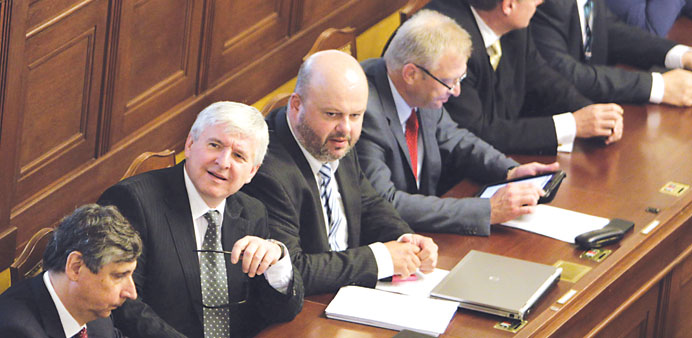
Rusnok (second left) and other members of his cabinet attend the parliamentary session in Prague yesterday.
AFP/Prague
Czech deputies voted yesterday against dissolving parliament and holding snap elections after a corruption scandal that forced the previous government to resign.
The motion failed as expected with 96 deputies voting to dissolve parliament, short of the three-fifths majority of 120 votes needed under the constitution. Ninety-two members voted against.
The left-wing Social Democrats – tipped by pollsters to win any election – tabled the dissolution vote amid political turmoil sparked by a bribery and spy scandal.
Their chairman Bohuslav Sobotka called snap elections “the best option for Czech citizens”.
But right-wing parties, which have seen their popularity plunge in part because of the scandal, voted against dissolution. Polls suggest they would lose snap elections.
The high-profile bribery and spy affair forced right-winger Petr Necas, 48, to step down as prime minister in mid-June. He had been in office since 2010.
This paved the way for veteran leftist President Milos Zeman, the Czech Republic’s first directly elected head of state, to install a technocrat cabinet led by his long-time ally Jiri Rusnok, 52, last week.
With parliamentary parties of all stripes feeling snubbed, analysts say that the technocrat economist Rusnok is unlikely to win a separate confidence vote that must be held by August 9 and requires backing from a simple majority of lawmakers in the 200-seat chamber.
“Right now it seems they (Rusnok cabinet) will not pass, but they are not completely without a chance as certain political interests might win them backing,” said Josef Mlejnek, an analyst at Charles University in Prague.
“Some lawmakers don’t want to go, they have mortgages. Someone may promise them that if they back the cabinet, it will take decisions in their favour,” he told AFP.
Zeman, 68, is himself a key player in the political horse-trading preceding the confidence vote, says Mlejnek.
“He has announced that he would lead intense talks on support for the cabinet, which is a brand new thing that changes the constitutional conventions as we know them,” said the analyst.
But even if Rusnok fails to win a vote of confidence, Zeman could still keep his cabinet in power until the next regular election in May 2014.
He could take advantage of a constitutional loophole to avoid naming a new prime minister-designate.
The crisis struck on June 13 when Necas’s chief-of-staff and lover Jana Nagyova was charged with bribery and abuse of power along with seven other senior figures including military intelligence heads and former lawmakers.
Prosecutors believe Nagyova had military spies tail Radka Necasova, Necas’s wife of 25 years with whom he has four children and is now divorcing.
They also claim Nagyova offered lucrative jobs to three rebel lawmakers from Necas’s own party in exchange for their resignations.
Necas has played down the allegations as political horse-trading.
The prosecution’s case suffered a blow on Tuesday when the Supreme Court ruled that the former lawmakers were protected by immunity when they took the jobs.
All three have been released from police custody.
High Prosecutor Ivo Istvan said he was shelving any possible charges against Necas pending a legal review of the scope of parliamentary immunity.