


|
|
The leading 20 nations in the world must work together, and quickly, to boost policies for jobs, the job market and social safety nets, the OECD and International Labour Organisation warned yesterday.
Young people are in a particularly tight spot when trying to get their first job, the Organisation for Economic Co-operation and Development and the ILO stressed.
Some G20 countries are struggling to overcome the effects of budget cuts, tax rises and deep reforms to control public spending, but the OECD-ILO statement highlighted the need for “sustainable” growth.
G20 finance ministers and central bankers meet in Moscow tomorrow and on Saturday, and on September 5 and 6 there will a G20 summit meeting in Saint Petersburg.
“The G20 will be assessed by public opinion around the world on its capacity to deliver on the growth and jobs agenda,” the statement said.
The key was balancing financial help for the unemployed with measures to encourage people “to find rewarding and productive jobs.”
This meant that all countries had to work together “towards the shared objective of strong, sustainable and balanced growth.”
In the joint statement before labour ministers from the Group of Twenty (G20) countries meet in Moscow today and tomorrow, they said that 93mn people were without work in the G20 economies earlier this year.
On average, about one third of these people had been out of work for more than a year.
In advanced economies, jobs had been lost mainly in the sectors of manufacturing and construction, whereas in several emerging countries construction had led the creation of jobs.
The economies of G20 countries would have to create 67mn jobs to raise the ratio of the people in work to the total workforce to the level before the financial crises began six years ago.
However “over the last 12 months, unemployment has dropped marginally in half of the G20 countries while it has risen in the other half,” the statement said.
“Unemployment is above 25% in South Africa and Spain, 11% or above in France and Italy and for the EU (European Union) as a whole,” the statement said.
It was above 7% in Canada, Turkey, Britain and the US.
However, it was below 6% in Australia, Brazil, China, Germany, India, Indonesia, Korea, Mexico, the Russian Federation and Saudi Arabia.
In most of the countries, the growth of real wages, after allowing for inflation, had slowed down or fallen.
Increased co-operation on enacting new policies which have been shown to work “would greatly enhance” the effect on employment.
“It is of utmost importance to restore stronger, sustainable economic growth,” the statement said.
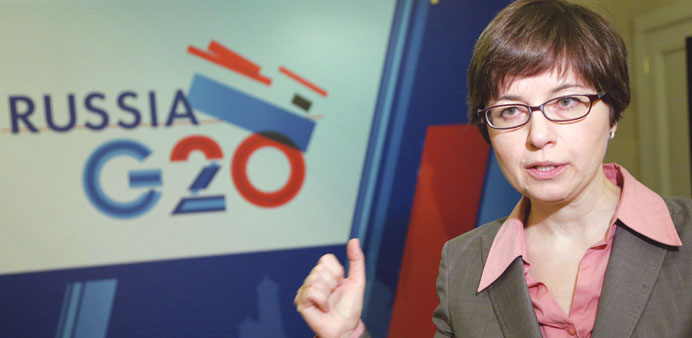
Meanwhile, Russia’s summit co-ordinator Ksenia Yudayeva said yesterday the G20 should brace for more market volatility even as an improving US economy allows the Federal Reserve to scale back its monetary stimulus.
She spoke after Fed Chairman Ben Bernanke told the US Congress that the US central bank still expects to start scaling back its massive bond purchases later this year, but left its options open in case the economic outlook shifted.
“The events we just saw have proved that we will not necessarily have less volatility — we will probably have quite a lot. We should rather prepare for this,” Yudayeva told Reuters iyesterday.
Even with consistent messaging, markets can be expected to be volatile, as they were during the Latin American debt crisis of the 1980s or the Asian crisis of 1997, as markets adjust to a new reality, said Yudayeva, a US-trained economist.
“Consistent and clear messaging is important but it will not necessarily stop volatility. It can decrease volatility a bit — but it cannot get rid of it,” she added.
Yudayeva said G20 officials meeting in Moscow will seek greater clarity on how China planned to deal with its economic slowdown and strains in its financial sector. “It would be good if China provided more information”.
Yudayeva, just back from a trip to Washington, also said officials there continued to oppose calls for G20 countries to make firm commitments to curtail their borrowing.
The greater US concern is that Europe, and its largest economy Germany, should take steps to revive a broad weakening of economic activity, she added.
“The main point of the Americans is not that they are resisting flexible, medium-term fiscal targets,” she said. “The major request is for the Europeans to go into some demand-stimulating policies.”