


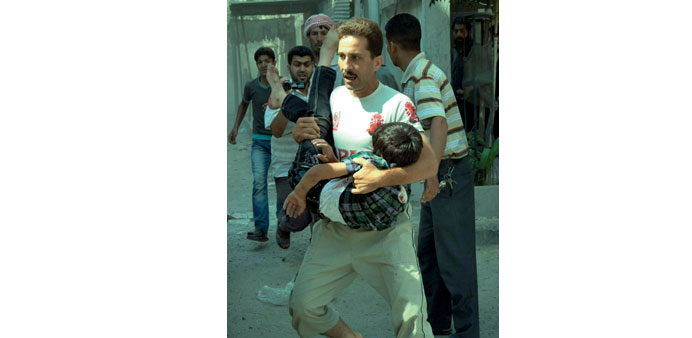
A man carries a boy wounded in what the Free Syrian Army said was an air raid by regime forces in the Duma area near Damascus on July 13.
AFP/United Nations
Five thousand people a month are dying in Syria’s war, which has now generated the worst refugee crisis since the 1994 Rwandan genocide, UN officials said yesterday.
A host of top officials called on the divided UN Security Council to take stronger action to deal with the fallout from the two-year-old civil war, in which up to 100,000 people are believed to have died.
“The extremely high rate of killings nowadays—approximately 5,000 a month—demonstrates the drastic deterioration of the conflict,” UN assistant secretary general for human rights Ivan Simonovic told a council meeting.
“In Syria today, serious human rights violations, war crimes and crimes against humanity are the rule,” Simonovic declared.
Nearly 1.8mn people are now registered with the UN in countries around Syria and an average of 6,000 people a day are now fleeing, UN High Commissioner for Refugees Antonio Guterres said.
“We have not seen a refugee outflow escalate at such a frightening rate since the Rwandan genocide almost 20 years ago,” Guterres added.
More than 2mn Rwandans fled the 1994 genocide, in which radical Hutus killed some 800,000 Tutsis and moderate Hutus in a period of about three months.
He said the acceptance of refugees by Lebanon, Iraq, Jordan and other countries was “saving hundreds of thousands of lives”.
UN humanitarian chief Valerie Amos said the international community may have to consider cross-border operations to get aid into Syria.
Amos added that $3.1bn was still needed for operations in and around Syria for the rest of the year.
She said 4mn people inside Syria need assistance and “considerable restraints” have been imposed on aid agencies by the government and rebel groups.
Amos highlighted the Old City in Homs, where the government has stepped up a siege in the past month. The UN estimates that 2,500 civilians are trapped there.
“Opposition groups have so far not enabled them safe passage to leave, and the government of Syria has refused to allow agencies to deliver assistance into the Old City,” she said.
Amos appealed for the lifting of bureaucratic obstacles but also the designation of “priority humanitarian routes” and prior notification of military offensives.
Amos said there should be “humanitarian pauses” to allow aid access and “cross-border operations, as appropriate”.
The Syrian government is opposed to any cross-border aid, as is Russia, a veto-wielding member of the Security Council and a key international backer of Syrian President Bashar al-Assad.
Turkey’s deputy UN ambassador Leven Eler backed the call, however. “The council needs to consider alternative forms of aid delivery, including cross-border operations,” he said.
Eler said the Syria crisis was turning into “the biggest humanitarian tragedy of the 21st century”.
Lebanon’s UN ambassador Nawaf Salam told the meeting it was now “urgent” for the Security Council to act on the refugee crisis.
“Increasing cross-border fire and incursions from Syria in Lebanon are threatening the security and stability of my country,” he told the 15 ambassadors on the council.
Salam said the UN has registered 607,908 refugees in Lebanon, but the government estimates the true figure at 1.2mn. He estimated the number would grow 20-fold during 2013.
Lebanon has a population of about 4mn, and he said the influx was the equivalent of 75mn refugees flooding the US.
Pro-regime militia
kills mediators: NGO
Members of a Syrian pro-regime militia gunned down seven Sunni men working on reconciliation in the central province of Homs overnight, the Syrian Observatory for Human Rights said yesterday. “Seven men belonging to a reconciliation committee, including two retired officers and the imam of a mosque in the town of Zara... were killed yesterday by members of the People’s Committee,” the group said, referring to a pro-regime armed group.