


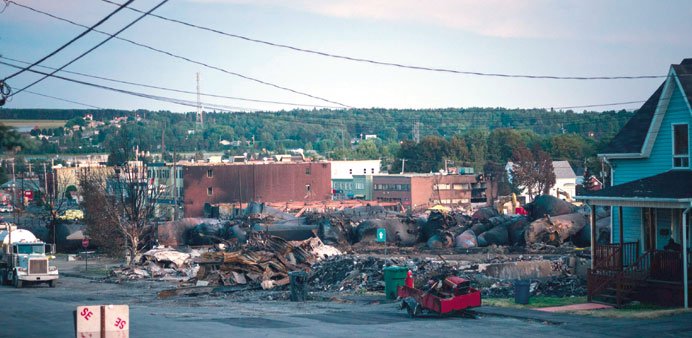
The “red zone” train crash site in Lac-Megantic, Quebec.
Reuters/Lac-Megantic, Quebec
A small Quebec town devastated by the deadliest North American rail crash in more than 20 years faces a slow and painful return to a more normal way of life, with even the funerals of the dozens of victims likely to be delayed by weeks or months.
About 50 people are believed to have died when a runaway train with 72 oil tanker cars crashed and exploded in the centre of the Quebec lakeside town just over a week ago, although not all the bodies have yet been recovered, and only 11 have so far been identified.
“We’re waiting for them to find her,” local businessman Real Breton said of his daughter, Genevieve, an aspiring singer who was inside Lac-Megantic’s popular Musi-Cafe when the train barrelled into town and burst into flames. “It’s terribly painful. You can’t even have a funeral.”
The coroner has not yet released any of the badly burned bodies to their grieving families.
“We have bodies and parts of bodies in various states, so there are some in worse condition than others,” spokeswoman Genevieve Guilbault said.
Guilbault said the painstaking process of identifying the victims was going better than expected and she was “encouraged rather than discouraged” that all the remains would eventually be identified.
But the coroner cannot release bodies as quickly as would normally be the case, because the remains are part of a still-open investigation. “It is impossible to know how long the delays will be,” she said.
The centre of Lac-Megantic remains closed to residents and to visitors while police and investigators sift through wreckage and tear down buildings structurally unsound since the disaster, which has reopened the debate about the safety of moving crude oil by rail.
Some downtown business are reopening in new locations, rather than waiting for their beloved city centre to reopen.
Musi-cafe owner Yannick Gagne, who lost three employees and dozens of acquaintances in the crash, said he is looking for a new spot for his cafe because he can’t afford to wait for downtown Lac Megantic to recover.
“It will take years, years,” Gagne said. At St Agnes church, just a few hundred metres from the flattened downtown area, numerous names dot a makeshift shrine erected in honour of the missing.
The town will hold a public memorial service at the church on July 27, but there will be no urns or bodies.
“This ceremony will allow the community here, along with all the people of Quebec, to pay homage to the victims of the tragedy,” said parish priest Steve Lemay, describing the mass as an important step in the town’s grieving process.
Canada’s Transportation Safety Board is probing the cause of the crash, focusing in part on whether enough hand brakes were been set to hold the train in place in its parking spot some 13km from Lac-Megantic.