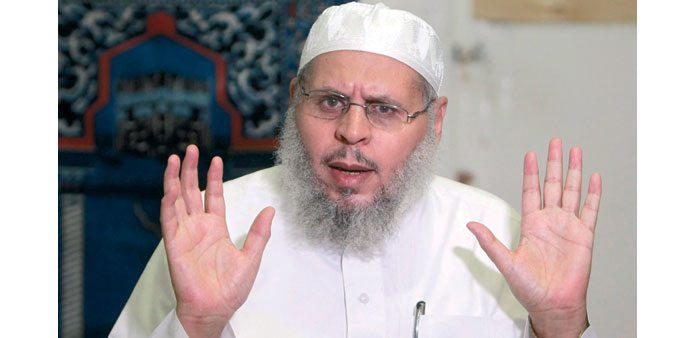
Abdel Akhir Hammad, spiritual leader of Gamaa Islamiya, gestures as he speaks during an interview with Reuters in Assiut.
Reuters/Assiut, Egypt
Reconciliation between Egypt’s Islamist and secular politicians is impossible unless deposed President Mohamed Mursi is reinstated, a leading Islamist told Reuters, but played down any suggestion that his movement might return to its violent past.
Abdel Akhir Hammad, spiritual leader of the formerly militant group Gamaa Islamiya, said that joining an army-backed transitional government or participating in elections would amount to giving his group’s blessing to military rule.
“Gamaa Islamiya’s position is a position of principle, and it is to not participate in a government that came by way of the army’s tanks,” Hammad said in an interview in the southern city of Assiut, where his group was formed in the 1970s.
The army toppled Mursi earlier this month and has struggled to persuade the Islamists, who have dominated elections held since a 2011 uprising ousted autocrat Hosni Mubarak, to sign up to its political transition plans.
Gamaa Islamiya waged a bloody insurgency against Egyptian security forces in the 1990s in an attempt to overthrow the Mubarak government and create an Islamic state. It was blamed for the 1997 massacre of tourists at an ancient Egyptian site in Luxor but after hundreds of deaths and thousands of arrests, the movement eventually renounced violence.
“Our view is that reconciliation truly begins with the return of legitimacy,” said Hammad. “We haven’t returned to legitimacy, so reconciliation would be like a wound you haven’t cleaned and then you closed and bandaged. You need to clean it first, and this cleansing is the return of legitimacy.”
Hammad’s views in the interview, conducted on Saturday, were personal. However, they give an insight into the thinking of a group that has significant political sway in southern Egypt and has been one of the most reliable allies of Mursi’s Muslim Brotherhood, Egypt’s biggest Islamist movement.
His comments underline the authorities’ problem in winning over Islamists, whom the government needs to create consensus, restore stability and take some unpalatable steps to heal the ailing economy, such as cutting fuel subsidies.
At the same time the Islamists, including the Brotherhood, face an uncertain future as their demand for the return of Mursi - who is being held incommunicado at an undisclosed location - seems increasingly impractical.