


By Gautaman Bhaskaran
It seems like the era of biopics in Indian cinema, more specifically, Hindi films. We have had the lives of men and women like Emperor Akbar, Phoolan Devi, Silk Smitha and Paan Singh Tomar captured on screen – sometimes ably, sometimes not so ably.
While Ashutosh Gowariker’s Jodha Akbar was a sketch of the Mughal king through songs, dances, opulence and finery that mocked at history, Shekhar Kapur’s Bandit Queen on the Rani of Chambal (Phoolan Devi) was tailored for the Western audience.
In recent times, Milan Luthria’s inspired-by-real-life The Dirty Picture — which set about telling the tragic tale of the South Indian actress specialising in the daring and the erotic, Silk Smitha — was, despite an excellent performance by Vidya Balan, scripted so shoddily that the movie turned out to be more sensational than substantive.
This has been the flaw with much of Indian cinema, which while claiming the right to artistic liberty tramples on authenticity leaving behind a mishmash of exaggerations fed through meaningless music, silly songs and dreary dances.
Yes, there have been pleasant exceptions: Tigmanshu Dhulia’s Paan Singh Tomar on the life of a champion steeplechase runner who was forced to degenerate into a dacoit (nay, rebel as the man would want to be known) by an uncaring society. Dhulia’s script and helming complimented Irrfan’s brilliant rendering of the sporting hero. I really could not find a single false note in the film. It was not verbose, and no scene seemed out of place or over the top.
In contrast, the latest biopic — on yet another sportsman – Rakeysh Omprakash Mehra’s Bhaag Milkha Bhaag, turns out to be a typical Bollywood fare complete with all the trappings that go with the genre.
Milkha Singh ran so fast breaking so many records and humbling so many world class sprinters that he was nicknamed Flying Sikh. For the speed with which he darted across tracks, Mehra’s movie, in contrast, comes as an apology. At over three hours, Bhaag Milkha Bhaag crawls, weighing itself down with a romance between the runner and Biru (played by Sonam Kapoor), a one-night stand with a young Australian girl during the 1956 Melbourne Olympics and finally a peace mission to Ayub Khan’s Pakistan. Where we see Singh beat a Pakistani champion at the friendly races. But, of course.
The film ends up as a meandering version of Milkha’s real story, glorifying the runner’s unsavoury incidents, including the death of his parents during the bloody riots in a Pakistani village after the 1947 partition of the subcontinent and the suffering of his elder sister (Divya Dutta) in a Delhi refugee camp. This is achieved through melodramatic sound and imagery.
Mehra’s work begins with the best known aspect about his protagonist, his defeat at the 1960 Rome Olympics, a race which he loses badly probably because of a momentary distraction when he turns to look back. This is followed by his days in the Indian Army, which help him discover and nurture his athletic talent.
Probably, what I liked best about the movie is a passionate and realistic portrayal of Milkha Singh by Farhan Akhtar. He is naïve, dreaming about glory in a blazer with an India emblem on it. He is like a child agreeing to participate in a marathon only because a win would help him get milk and eggs.
He innocently replies that he is Milkha Singh, when the Australian girl asks him whether he is relaxing. Akhtar is comical, serious and foolish — endearing himself to all of us, despite situations which appear contrived.
The only other actor worth mention is Pavan Malhotra, who is a treat to watch as Singh’s coach and well-wisher. Sadly, a good actress like Dutta is wasted in a role that is clearly too affected. We then have an over-acting Prakash Raj, a Sonam Kapoor who flits unimpressively through the scenes and a Dalip Tahil awfully caricatured as Jawaharlal Nehru.
Oh! to be a critic
In my long years as a film critic, I have often got brickbats, rarely bouquets. Sometimes, nasty and personal comments have been flung at me. I have even been accused of playing favourites, of running down Indian cinema. I have been anguished, heart-broken, but have learnt to cope with this.
I am always asked why is it that I seem to love Hollywood, running down Bollywood in the process. I have replied – always – that I was merely comparing one with another. I have compared European cinema with Indian. I have compared Malayalam cinema with Tamil, Bengali with Hindi and so on and so forth. I have no favourites. I cannot, as a critic. No, never.
Furthermore, my retort to my “He Loves Hollywood” detractors has been: How are we going to improve if we do not compete with someone better than us, and it is not that every Hollywood movie is a study in excellence. I have been harsh in my lampooning of American cinema as well. I described Baz Luhrmann’s Moulin Rouge as a film without a soul. I called Danny Boyle’s Slumdog Millionaire a “celebration of poverty”, a view shared by the Greek master, Theo Angelopoulos and Indian greats like Adoor Gopalakrishnan and Girish Kasaravalli.
But, but, if mainstream Indian cinema has to reach the skies, in fact the kind of heights it once enjoyed, it must now turn the mirror on itself.
Will anybody be kind enough to tell me whether men like Bimal Roy, Guru Dutt, Hrishikesh Mukherjee and even early Raj Kapoor made art movies? No, they did not. At least they were not labelled so. They made films which were acknowledged as part of mainstream fare, complete with songs and dances that catered to the masses’ tastes and culture, so to say. Yet, their works were hailed, even critically, because what these directors created was arrestingly authentic and they were marvellous studies of society and human behaviour.
And, let us not forget that we do not live in a unipolar world. Indian movies have to travel and most Indians want that. Is this not why that year after year Indian cinema wants to be part of the Cannes Film Festival? Why is it that for decades, Indian cinema has been striving so hard to be at least nominated for the Academy Awards? Because, Indian cinema wants to be up there, but, sadly, has done precious little to achieve that – by way of gripping and realistic scripts – and by way of excellence in helming and performance.
Finally, to all those who lambast me, here is my footnote. I can either be a journalist or a public relations guy. I cannot wear two hats at the same time. For years, I have seen critics in Chennai happily accept an envelope each from the producer and that too right after a press screening. We all know what that cover contains.
I have fought against such temptation, and now I am never invited for a press screening of a Tamil movie!
* Gautaman Bhaskaran has been writing on Indian and world cinema for over three decades and may be e-mailed
at [email protected]
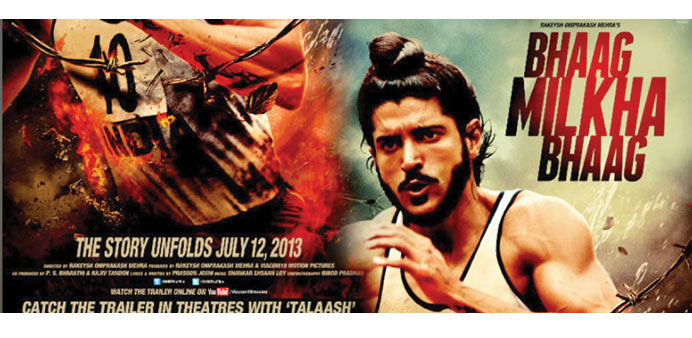
Bhaag Milkha Bhaag: At over three hours, the film crawls.