


|
|
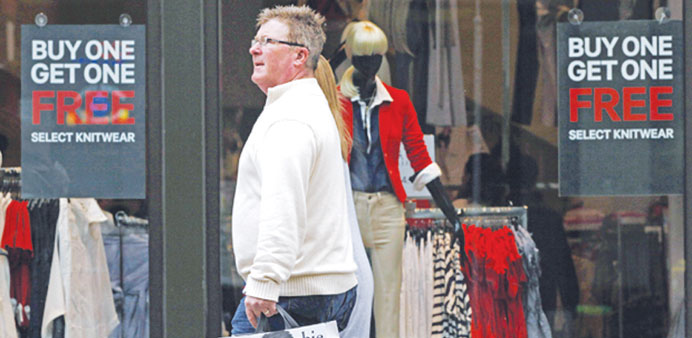
US retail sales rose less than expected in June, the latest sign of a slowdown in economic growth that could argue against the Federal Reserve’s plan to start trimming its monetary stimulus later this year.
But growth is not slowing abruptly, with other data yesterday showing factory activity in New York state accelerating in July as new orders and employment improved.
Retail sales increased 0.4% last month, lifted by demand for automobiles and higher gasoline prices. However, sales of building materials fell by the most in a year, a potentially worrying sign for the housing market.
Sales had increased 0.5% in May. Economists polled by Reuters had forecast retail sales, which account for about 30% of consumer spending, rising 0.8% in June.
So-called core sales, which strip out automobiles, gasoline and building materials and correspond most closely with the consumer spending component of gross domestic product, edged up 0.1% after rising 0.2% in May.
“It provides no additional evidence that the economy is gaining momentum,” said Annalisa Piazza, a senior economist at Newedge Strategy in New York. “It doesn’t allow the Fed’s chairman to have a firmer tone as the US economic recovery remains gradual.”
The suggestion of slower domestic demand as well as recent weak trade data comes as the Fed is debating cutting back the $85bn in bonds it is purchasing each month to keep borrowing costs low and stimulate the economy.
Fed Chairman Ben Bernanke said last month the central bank would start tapering its purchases later this year and would likely bring the programme to a complete close by the mid-2014 if the economy progressed as it expected.
But he has since stressed that the Fed needed to keep a stimulative monetary policy in place given the low level of inflation and a still-high unemployment rate. Bernanke will testify to congress on the economy later this week.
The slowdown in growth in the second quarter mostly centred around consumer spending, trade and manufacturing. But there are hopeful signs for the factory sector.
A separate report showed the New York Fed’s “Empire State” general business conditions index rose to 9.46 this month from 7.84 in June. A reading above zero indicates expansion in the region’s factories.
The survey’s measure of new orders rebounded into positive territory, while gauges of employment improved.
A brightening labour market picture is helping to support spending. Last month, receipts at auto dealerships rose 1.8% after advancing 1.4% the prior month. Excluding autos, sales were flat after rising 0.3% the prior month.
Sales at building materials and garden equipment suppliers fell 2.2%, the weakest reading since May last year.
Meanwhile, the Commerce Department said US business inventories rose marginally in May as sales rebounded, adding to a raft of data that have pointed to a sharp slowdown in economic growth in the second quarter.
The Department said yesterday inventories edged up 0.1% after rising by a revised 0.2% in April. Economists polled by Reuters had forecast inventories unchanged in May after a previously reported 0.3% gain.
Inventories are a key component of gross domestic product changes. Retail inventories, excluding autos — which go into the calculation of GDP — increased 0.3% after rising by the same margin in April.
Businesses are being cautious about restocking against the backdrop of lacklustre domestic demand. The report suggested inventories will be less of a boost to GDP this quarter.
The business inventories report comes in the wake of data this month showing a sharp widening in the trade deficit, which prompted economists to slash their second-quarter GDP estimates.
Inventories added more than half a percentage point to first-quarter GDP growth, which advanced at a 1.8% annual rate. Estimates for growth in the April-June period currently range as low as a 0.5% pace.
Business sales increased 1.1% in May after being flat the prior month. At May’s sales pace, it would take 1.29 months for businesses to clear shelves, down from 1.30 months in April.