


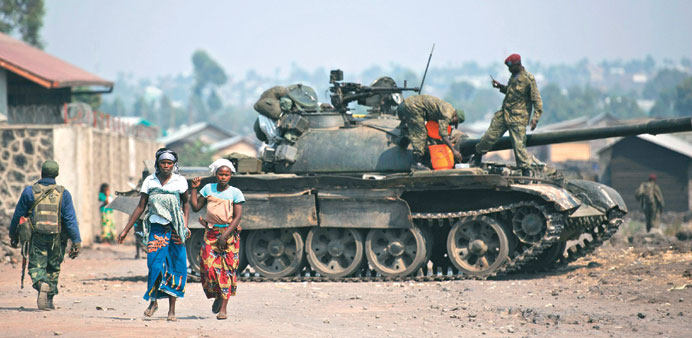
Two Congolese women walk past a government army tank in Munigi on the outskirts of Goma.
Reuters/Muja, Democratic Republic of Congo
Fierce fighting raged for a second day yesterday between Democratic Republic of Congo’s army and M23 rebels near the eastern city of Goma, underlining the challenge facing a UN Intervention Brigade tasked with bringing peace.
At Muja, a village some 11km from Goma, government forces used heavy weapons to try to drive back M23 fighters after clashes erupted on Sunday afternoon, ending several weeks of relative calm.
The rebels alarmed the international community in November by seizing Goma, a city of 1mn people on the shore of Lake Kivu, prompting the speedy deployment of the UN brigade.
The 3,000-strong force drawn from South Africa, Tanzania and Malawi has a tough mandate to crush armed groups and end decades of unrest in eastern Congo, but it has yet to enter combat.
“We are going to chase the enemy very far from Goma so that they will not have a chance to recapture the town,” army spokesman Colonel Olivier Hamuli told Reuters television in Muja. “We want the population of this village to be able to return home because people are tired.”
Each side blamed the other for opening hostilities on Sunday. Fighting resumed yesterday at 5.30am local (0330 GMT) after calm descended overnight, Hamuli said.
In Kinshasa, government spokesman Lambert Mende said the M23 had sustained heavy losses in Sunday’s fighting.
“Some 120 of its fighters were killed in the clashes yesterday. In army ranks, we lost 10 of our valiant fighters,” Mende said.
Both sides in the conflict routinely inflate enemy casualty figures and an army official on the ground in eastern Congo said it was too early to give a precise figure.
M23 spokesman Vianey Kazarama said the rebels held the upper hand and would fight on until the government offensive was repulsed.
The arrival of the new Intervention Brigade, which has begun patrolling and is approaching full strength, has raised hopes of an end to the conflict. The World Bank is offering $1bn in funding to regional governments to promote development if they respect a peace deal brokered by the UN in February.
Peace talks between the Congolese government and M23 in Kampala, the capital of neighbouring Uganda, have stalled.
Congo has long accused neighbouring Rwanda of backing the Tutsi M23 rebels and a UN panel of experts report said the rebel group recruits in Rwanda with the aid of sympathetic military officers. Kigali has denied any support for M23.
In a letter to UN diplomats seen by Reuters on Monday, Rwanda accused the intervention brigade of discussing collaboration with the FDLR, a group of Hutu rebels linked to the Rwandan genocide of 1994, in order to take on M23.
Aside from M23 and the FDLR, dozens of other armed groups are active in mineral-rich eastern Congo.
Some 66,000 Congolese refugees have fled into Uganda after an offensive launched by the Ugandan rebel Allied Democratic Forces (ADF), an Islamist group that Kampala says is allied with elements of Somalia’s al Qaeda-linked Shabaab movement.
UN threatens ‘lethal force’
The UN said yesterday it is ready to use “lethal force” to stop a rebel advance on the Democratic Republic of Congo city of Goma after major new clashes erupted.
The UN has deployed a 3,000 strong intervention brigade in eastern DR Congo in recent weeks. The joint South African, Tanzanian, Malawian brigade has an unprecedented strong UN Security Council mandate to take on armed groups.
The DR Congo “mission has put its troops on high alert and stands ready to take any necessary measures including the using of lethal force to protect civilians,” UN spokesman Martin Nesirky told AFP.
“Any attempt by the M23 to advance toward Goma will be considered a direct threat to civilians,” he added.
The M23, which has forces around Goma, has reinforced its positions with “heavy artillery” and a “battle tank,” MONUSCO said.