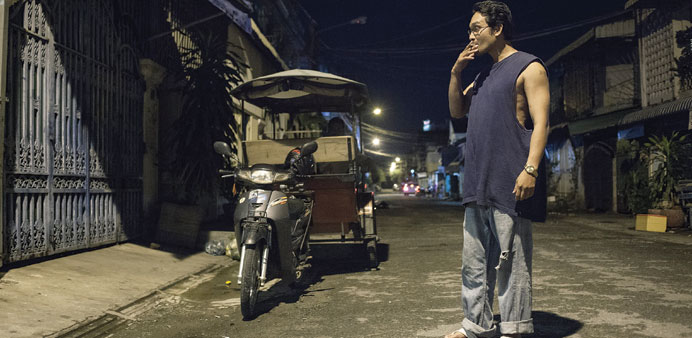
Ros Choun was tried as an adult at the age of 16 for firing a weapon in a public school in Atlanta, Georgia. Immigration authorities took him into custody years later and he was deported back to Cambodia.
By Kit Gillet
Sitting in a dingy bar down a small back alley in the Cambodian capital, Ros Choun struggled to explain how he ended up here. “They took my whole life, and there is nothing I can do about it,” he said.
Despite the location and his Cambodian appearance, Choun had spent almost his entire life in the United States. In fact, at 35, he refuses to consider himself anything but American. His family, he recounts, sought refuge in America in the early 1980s after fleeing the genocide and devastation of the Khmer Rouge period, which left Cambodia in ruins and almost 2mn people dead.
“I was 6 months old when I left this country — I’m American — but no one told us if we go to prison we could get deported back to Cambodia,” he said, his eyes downcast and his voice filled with anger.
Since 2002, hundreds of ethnically Cambodian men and women have been deported from the United States to Cambodia in barely recognized fallout from a tough immigration law passed in 1996 during the administration of President Bill Clinton and an agreement, reached after the September 11, 2001, terrorist attacks, that allowed the deportation of any Cambodian convicted of an aggravated felony who hadn’t earned US citizenship.
Few of those who arrived in the US as traumatised refugees in the late 1970s and 1980s realised that asylum and residency were not the same as citizenship. “I didn’t know anything about any of this until 2011,” said Aun Khoy, 51, a deportee who arrived as a teenager in the US and who was deported back to Cambodia two years ago for a decades-old manslaughter conviction.
What started as a trickle of deportations has, in recent years, turned into a flood, with the number of deportees increasing dramatically since 2009 and the total number now estimated at around 400. “It’s averaged about 10 deportees a month between 2009 and now,” said Keo Sarith, the programme director at the Returnee Integration Support Centre, a Phnom Penh-based nonprofit set up to help those repatriated.
Another 2,000 ethnic Cambodians in the US are on the deportation list because of their criminal records and could be picked up at any time.
“Many individuals are going about their ordinary lives. Working, studying, raising their families, but any knock on the door could be the immigration officers,” said Bill Herod, an American pastor who lives in Cambodia and has been involved in helping the returnees since the first groups arrived in 2002. “It’s a terrible injustice, but it’s legal.”
Choun was picked up three years ago from his family’s home in Atlanta and, after a year-and-a-half wait in detention, put aboard a plane to Cambodia. His crime: As a 16-year-old he had fired a gun at school to intimidate a group of bullies. He was tried as an adult and spent seven years behind bars, but on release he thought he could put it all behind him.
“For a decade after I was released I had no issues with the law. Ten years working, paying taxes and not even a traffic ticket,” he said, shaking his head.
Choun said there are other returnees whose plight is even worse. “We have a 72-year-old grandfather here. He hit his son for joining a gang in 1986,” he said. “He was a teacher and now he drinks his life away. You can’t get a job here if you are 70 years old.”
According to the Returnee Integration Support Centre, the returnees range in age from 25 to 82, with a significant number having spent time in jail for gang activities, drug dealing or violent crimes.
“These people were put in big cities in the US and left to their own, which led to drugs, violence, gangs,” Herod said.
Most of the deportees arrive in Cambodia with little more than the clothes on their backs and what money they have in their pockets. US marshals escort them off the plane, but there’s very little to sustain them when they arrive.
Many spend their first few weeks in one of the small, bare rooms above the support centre’s office near Phnom Penh’s airport. After that, they must make a new life in a country where poverty is common.
“The Cambodian government has enough people to worry about and just isn’t interested in them,” says the centre’s Keo.
Ken Touch arrived in Cambodia just over a year ago. It was the first time the 39-year-old had left the US since arriving from Cambodia as an infant.
“I’m living day by day,” he said, sitting in a small coffee shop on the outskirts of Phnom Penh, his elaborate tattoos distinguishing him from those around him.
In 2000, Touch was involved in a bar fight and shot someone in the thigh. After 10 years in prison and another year in an immigration detention centre, he arrived in Cambodia.
“I knew after being released I would get deported. The whole time I was in prison I had that hanging over my head,” he said.
Money is tight. His family sends him a few hundred dollars a month, and the rest of his money comes from picking up paying passengers on his motorbike.
“I have another 13 days to make it to end of the month. I hate eating the same thing every day, but I will survive,” he said.
Like many, one of the biggest difficulties for Touch is knowing that unless the law changes he will never be allowed back into the US, even on compassionate grounds.
“Those who get sentenced to life in prison in the US at least get to see their families at weekend visitations, and if someone dies they take you to the funeral,” he said. “If my parents pass away I won’t even get to attend their funerals.”
Many of the returnees struggle with their enforced new reality, far from everyone and everything they know. Few speak Khmer when they arrive, and it can be hard to find employment.
“About 10% of the returnees do OK, they get settled, find jobs and start families,” Herod said. But for others, life is a constant struggle. “We’ve had suicides, overdoses — around 17 are in prison right now for crimes they have committed since arriving in Cambodia,” he said.
In 2003, Herod lost the sight in his right eye after liquid splashed into it while he was wrestling a bottle of Drano out of the hands of one of the returnees who was attempting to drink it.
“He later successfully committed suicide,” Herod said sadly.
Choun said life is particularly hard because he left his three children behind in Atlanta. There’s no money for them to visit.
“I can’t bring myself to explain everything to my kids,” he said. “I just tell them I am on work leave and then hope that one day I can return, even if just for a visit.” — MCT
Many visa fraud
cases discovered
at US airports
By Alfonso Chardy
On June 7, Luis Barrera arrived at Miami International Airport (MIA) aboard a flight from Caracas. He was arrested soon after presenting to Customs and Border Protection (CBP) officers a Venezuelan passport containing a US visa obtained at a US consulate in Venezuela.
Barrera was charged with visa fraud, not because his visa was fake, but because he had used it again after illegally overstaying his allotted time twice before.
Barrera was only one in a long string of foreign nationals arrested at airports around the US on visa charges in the last year. One common denominator in many of these cases is that the defendants have previously overstayed their visas, entered the United States illegally or been deported.
Another commonality is that the travellers have been discovered by CBP officers on arrival in the United States, not by State Department consuls when they apply for visas abroad. While it would seem consuls are issuing visas to foreign nationals who are not entitled to them, US officials say the consuls are doing their job properly.
Consuls generally issue five- and 10-year visas to foreign travellers who apply for them. But these visas are not a guarantee that the travellers will be automatically admitted into the United States. That decision rests with CBP passport control officers who generally grant six-month stays to travellers with the long-term visas issued by consuls. If the traveller leaves the United States before the authorised time expires, then he can use the long-term visa again. If there is an overstay, he could be denied entry or arrested if fraud is detected.
A State Department official explained that foreign nationals with genuine visas who are denied entry because of prior transgressions generally carry visas good for five or 10 years.
These visas are issued for multiple entries into the United States with the understanding that visitors must leave the country at the end of their authorised time. If they overstay, the visa becomes invalid when they try to return.
On arrival, CBP generally gives a foreign visitor six months to stay in the United States. But if these visitors overstay their allotted time, consuls would only become aware of the violation when the foreign national tries to renew the long-term visa, the official said.
Thus, CBP officers are the ones who discover the violations when the foreign visitors attempt to return to the United States using the same long-term visa. Fraud cases in Miami federal court do not indicate whether the foreign visitors arrested carried long-term visas.
But in the case of Barrera, who was arrested June 7, a CBP investigator said the defendant added false entry stamps to his passport showing he had returned to Venezuela from the United States before his visa time expired.
By examining these stamps closely, CBP investigators concluded Barrera had overstayed twice — once in 2007 and again in 2009.
“During secondary interview, the defendant admitted that he had overstayed two entries and obtained the backdated stamps to conceal his overstays in the United States,” the CBP investigator said in an affidavit.
Barrera’s attorney could not be reached for comment.
Other cases, however, clearly leave the impression that foreign visitors obtained their visas by lying to a consul who did not immediately discover a prior overstay.
For example, Danielle Cristina Rodrigues dos Santos, who arrived at MIA on June 9 on a flight from Belo Horizonte, Brazil, was arrested after admitting to CBP that she lied on her visa application to conceal a prior 10-year overstay. Rodrigues’ attorney declined to comment on the case.
A State Department official said US consuls abroad do not accept a visa applicant’s claims without verification. But the official indicated that in some cases the information to verify an applicant’s statements is not readily available.
“Even as we welcome increasing numbers of travellers to our shores, security remains our highest priority,” the State Department official said. “We take our role in protecting our borders very seriously, and we believe that every visa decision is a national security decision.”
Another issue that may make it difficult for US immigration officials to quickly discover overstays is the lack of departure control at airports and borders.
US passport control officers do not examine the documents of departing international passengers. At airports, airline personnel are expected to retrieve arrival forms from departing foreign visitors.
The bipartisan immigration bill the Senate passed June 26 would mandate the creation of a system to track the departure of foreign nationals by air and sea. The bill would also seek to improve methods to detect visa overstays. — El Nuevo Herald/MCT