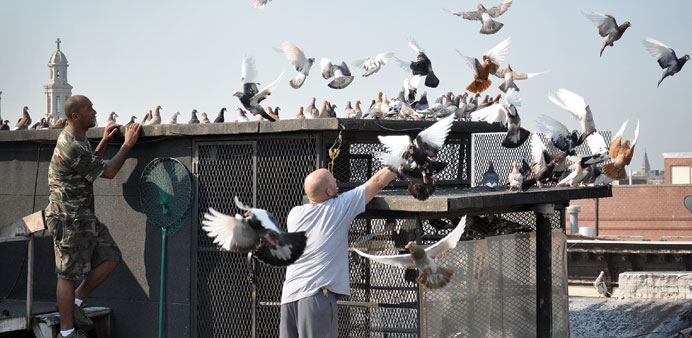
‘Tree’ and Mike Scott at their pigeon loft in New York. They do not simply raise pigeons, but regard their hobby as a sport.
By Jan Willems
Seen from the street, the pigeons can scarcely be made out. Their world is the rooftops of Brooklyn. There, the “pigeon flyers” do not simply raise pigeons, but regard their hobby as a sport.
Several times a day they climb up to the roofs of their apartment buildings and let hundreds of the birds take to the skies, flying in tight formations and performing aerial manoeuvres.
At street level, the pigeon fans like to meet at the “Broadway Pigeon & Pet Supplies” shop located directly beneath a subway bridge. Joe Scott, a gruff-looking man with close-cut grey hair who’s in his mid-40s, runs the store along with his brother Mike, who almost looks like a twin.
Every Sunday morning, the neighbourhood’s pigeon flyers gather to trade notes and maybe make a bird deal. On a recent Sunday morning a man called Louie is sitting on a folding chair in front of the store. The 50-something Louie earns money for his family and some 250 pigeons as a bicycle courier on the streets of New York. For Louie, the birds help him cope with the stress of his daily battle with the traffic of Manhattan.
“It helps me to calm down,” he says of his hobby, smiling. “Pigeons are the best therapy.”
Louie purchased his first pigeons at the age of nine. He knows that things were not always so peaceful among the pigeon flyers as is the case nowadays.
“In the 1980s, when there was at least one rooftop pigeon coop on every block, it was like a war,” he recalls. The problem was that when several pigeon keepers let their flocks loose at the same time, some birds would return to another keeper.
“Back then, the birds weren’t simply returned,” Louie said. Today, such disputes are rare. Usually a “finder” might bargain for a couple of dollars before returning a pigeon to its owner.
But now the problems are coming from outside the scene. Authorities are demanding a lot of money for a licence to keep a pigeon coop. And many landlords and neighbours don’t like having thousands of pigeons living up on the roof of their buildings.
It’s something that a giant of a man that they call “Tree” has painfully experienced. A few blocks away from the pigeon supply store, the man in his mid-40s is sitting outside Mike Scott’s house.
“A couple months ago they made me give up my flock,” Tree said. “After all these years it suddenly bothered some neighbour. Somebody complained to the landlord and I had to get rid of hundreds of birds.”
All that remains are about 30 pigeons and a mobile phone video of their aerial manoeuvres that he proudly shows people. Tree mourns the bygone times, even the tough parts. “The scene isn’t the same anymore,” the huge man with the shaved head says wistfully. “Back then, when you caught a bird from another flock, you simply kept it. Those were the rules.”
Then he proudly shows his key chain on which rings of many colours are hanging — trophies of birds he caught in the past. Every pigeon keeper had his own colour of pigeon ring. “My rings were golden,” Tree says.
Now he helps to take care of the flock belonging to his old friend Mike, for the birds require a lot of care. If there are people who might dismissively regard pigeons as being “airborne rats” then Mike Scott can set them straight. Up on his roof, the pigeons appear clean, their feathers in multiple-nuanced shades and patterns of brown, white, grey and black.
The birds have names like “Roller” und “Tippler” after the kind of aerobatic manoeuvres they can fly or after some unique distinguishing mark on their bodies such as long feathers at their feet or raised collars.
Tree is now scanning the roof of the coop and eyes Mike’s birds, appearing deep in thought. Pigeon flyers might have differing perspectives about the rough 1980s scene, but they all share a love of the birds. — DPA