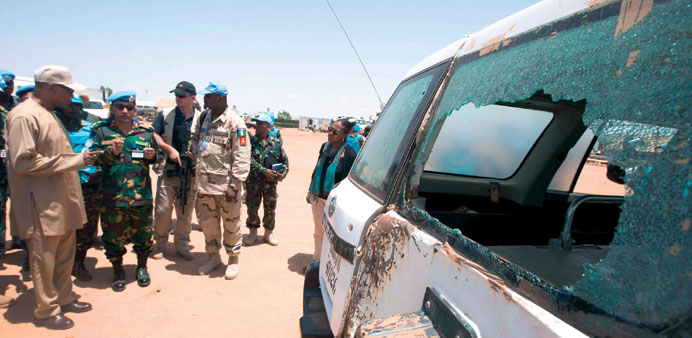
A UNAMID delegation inspects an ambulance that was damaged in Saturday’s ambush at Khor Abeche in South Darfur.
AFP/Khartoum
Rebels in Sudan’s Darfur region accused government-linked militiamen yesterday of staging an ambush which killed seven peacekeepers, but Khartoum blamed the insurgents.
The UN Security Council condemned the ambush and urged the Khartoum government “swiftly to investigate the incident and bring the perpetrators to justice”.
About 50 UNAMID members have now died in hostile action since the mission began five years ago, but UN sources say they are unaware of anyone having been held accountable.
Abdel Wahid Mohamed al-Nur, who commands a faction of the Sudan Liberation Army (SLA), said government “intelligence and militia” carried out Saturday’s attack which also wounded 17 other military and police personnel from the African Union-UN Mission in Darfur (UNAMID).
“They are doing this in order to frighten UNAMID and to shake the international community in order to withdraw this force,” he said.
Nkosazana Dlamini-Zuma, head of the African Union Commission, said “UNAMID will not be deterred” in its mission.
Sudan’s foreign ministry condemned the incident, expressed condolences to the victims’ families, and blamed “the so-called Sudan Liberation Army Minnawi faction... for this aggression”.
Abdullah Moursal, spokesman for the SLA group led by Minni Minnawi, earlier yesterday said: “We don’t have any doubt that the act was done by government militia, because militia are deployed in Khor Abeche area. This area is completely under government control.”
Khartoum “must take full responsibility for this incident”, said Gibril Adam Bilal, of the Justice and Equality Movement rebels. He claimed government-equipped militia carried out the attack.
UNAMID said the ambush by “a large unidentified group” struck about 25km west of a UNAMID base at Khor Abeche, north of the South Darfur state capital Nyala.
All of the dead were from Tanzania. It was the worst attack in UNAMID’s five-year history.
Rebels have been fighting the government for a decade in Darfur, but UNAMID says clashes between rival tribal and ethnic groups have been responsible for most of the worsening unrest there this year.
UN experts, human rights activists and tribal leaders have accused government security forces of involvement in this year’s tribal fighting.
UN Secretary General Ban Ki-moon expressed outrage at Saturday’s “heinous attack” and called on Khartoum to take swift action to bring the perpetrators to justice.
The UN has made repeated similar calls after attacks on its peacekeepers in Sudan but Herve Ladsous, the UN’s undersecretary general for peacekeeping, said in Sudan this month that “we have had little by way of information after past investigations” by Sudanese authorities into the attacks.
Khartoum yesterday pledged support for UNAMID and said it was committed to an “urgent investigation” to bring the culprits to justice.
An estimated 300,000 people have been displaced by violence in Darfur this year—more than in the past two years combined.
There were already 1.4mn people in camps for people displaced by Darfur’s conflict.
Nur, of the SLA, said authorities want UNAMID out of Darfur so they can empty the camps. He said UNAMID needs a stronger mandate to make it a “peacemaker”.
In April, a Nigerian peacekeeper was killed and two were wounded in an assault on their base east of Nyala.
The authorities denied suggestions by local sources that the attack appeared to have been planned and carried out by government-linked forces.
A UN panel of experts earlier this year reported that former pro-government militiamen had sometimes expressed their discontent with the current government through “direct attacks on UNAMID staff and premises”.
The JEM and SLA both refused to sign an internationally backed peace deal reached two years ago between Khartoum and an alliance of rebel splinter factions.
A humanitarian source expressed doubt that rebels would have carried out the attack on UNAMID.
“When people are killed, probably it’s more militia,” he said, asking for anonymity.
UNAMID released few details of the ambush but said the patrol came under “heavy fire”, leading to an extended firefight until reinforcements arrived to rescue the team.
Last October, unidentified attackers fired mortars and other heavy weapons in an ambush which killed a South African peacekeeper in North Darfur.
UNAMID said that attack may have been a deliberate attempt to prevent the mission from assessing the situation in an area where violence had been reported.