


By Jochen Neumeyer, DPA/Munich
The Munich court where accused neo-Nazi Beate Zschaepe is on trial for her alleged role in a series of robberies and racist murders has heard for the first time from a family member of one of the 10 victims.
Zschaepe, 38, is charged with being an accomplice to murder in the slayings of eight Turks, one Greek national and a German policewoman between 2000 and 2007 while a member of the National Socialist Underground (NSU) terrorist group.
In the witness box on Thursday was Pinar Kilic, widow of Habil Kilic, who prosecutors say was the NSU’s fourth victim.
Pinar Kilic was on holiday in Turkey as her husband took care of the family grocery store in Munich when he was murdered with two shots to the head in August 2001.
A tearful Kilic found it difficult to talk about her husband. “He was a very good man, a father. To me, he was a decent man. What am I supposed to say?”
Chief Judge Manfred Goetzl asked how Kilic had fared after her husband’s death, but she replied with more questions.
“When you lose someone, when you lose your business? When people talk badly about us? And they treated us like criminals? Can you imagine that?”
Zschaepe is believed to be the sole surviving member of the NSU.
The two other alleged members of the group, Uwe Boehnhardt and Uwe Mundlos, died in an apparent murder-suicide in November 2011 after a botched bank robbery.
Boehnhardt and Mundlos are thought to have been responsible for the racially-inspired murders, as well as a number of bank heists and bombings.
Sitting about 5m from Zschaepe, Kilic asked why she had to speak in the presence of “this woman”.
But Goetzl was insistent: “When I ask politely, I expect polite answers.”
Finally, Kilic described the “bloodbath” in her grocery store, which the family had to clean up themselves. She ultimately closed the store. “I couldn’t go on any more with all the blood.”
German police and intelligence agencies have been criticised for failing to detect the gang, for following false theories about the murders and for missing warning signs from within the far-right scene.
As with most of the other killings, the initial police investigation into the murder of Habil Kilic assumed a connection with the illicit drug trade.
Pinar Kilic said she was forced to move into a different apartment and her daughter had to go to another school. Friends turned their backs on them, she said.
The previously impassive Zschaepe repeatedly looked over to Kilic as she spoke.
Prosecutors became visibly agitated when Josef Wilfling, the leader of the police investigation into the Kilic murder, was called as a witness.
“In our judgment, this was an absolutely professional execution,” the now-retired Wilfling said.
Turning to Goetzl, he said: “You know very well that our crime scene unit works meticulously. Every square centimetre was searched. With the exception of the bullets, we didn’t find a single relevant piece of evidence.”
Several plaintiffs’ attorneys angrily demanded why there had been no search for right-wing extremists, and why police instead pursued connections with the drug underworld.
Wilfling replied: “Please let’s not act as if there is no such thing as the Turkish drug mafia!”
“It is no secret that there are also sick people in Germany who call themselves neo-Nazis!” retorted prosecuting attorney Adnan Erdal, accusing Wilfling of dealing in “half-truths”.
Goetzl finally called a close to the heated exchange, demanding that the two sides “settle down”.
But the tension remained after the court reconvened, with prosecutors wanting to focus on the charges against Zschaepe and throw out anything not directly bearing upon them.
The joint plaintiffs, however, intend to draw attention to mistakes made in the criminal investigations and to gather information on a possible NSU support network.
The court faces the challenge of balancing these competing interests as the high-profile trial continues.
In addition to attempted murder, Zschaepe has been accused of arson. She allegedly set fire to the apartment in the eastern German city of Zwickau that she shared with Boehnhardt and Mundlos. Four days later she gave herself up to police.
Zschaepe has refused to testify in the trial, which the court expects to run until the end of next year. Four other co-defendants in the trial are accused of assisting the NSU.
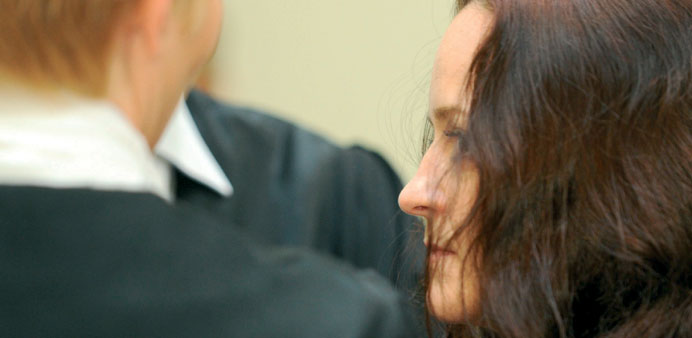
Zschaepe