


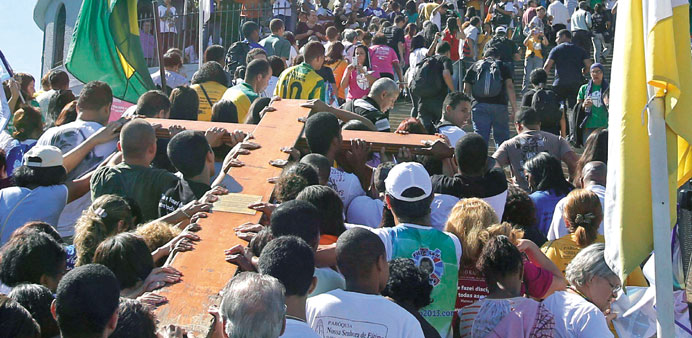
Youth carry the World Youth Day cross during a visit to the Penha sanctuary in Rio de Janeiro yesterday.
Agencies/Rio de Janeiro
Rio de Janeiro endured a night of violence as police and demonstrators clashed outside the state Governor’s Office, authorities said Friday.
Human rights organizations complained that riot police used tear gas, pepper spray and rubber bullets against protestors, who threw stones and Molotov cocktails at police.
Police arrested 56 demonstrators and stormed a hospital near the site, using tear gas to disperse protestors who had sought refuge inside the building.
The human rights organization Amnesty International, whose Brazil office is located near the site, condemned police use of excessive force.
“What is happening in Rio de Janeiro is a tragedy. Police show they are ill-prepared. They appear to be without command and acting of their own accord,” said Atila Roque, head of Amnesty International Brazil.
Governor Sergio Cabral said that harsh measures were necessary to prevent property damage by some protestors. “Vandalism will not be tolerated in the state of Rio de Janeiro,” he said.
“Groups that go out onto the streets with the clear intent to cause panic and destroy public and private property, seek to profit from the recent legitimate demonstrations by thousands of young people willing to take part in and perfect the democracy that the Brazilian gained with great effort.”
The clashes happened overnight, at the end of protests called by trade unions and social movements Thursday to call for various types of economic reform in Brazil including agrarian reform and a reduction in the work week from 44 to 40 hours.
Last month, mass rallies shook Brazil during the Confederations Cup. Demonstrators demanded better education, health and public transport while protesting corruption and the use of public funds to pay for stadiums and other infrastructure needed for next year’s World Cup.
Attending a summit in Montevideo of the Mercosur trade bloc, Brazilian President Dilma Rousseff expressed respect for peaceful protests and cited Brazil’s economic and social progress over the last 10 years under her Workers’ Party.
“Now, people want more, and that is a really positive thing in a democracy,” she said. “What we want is to expand such achievements and social rights.”
Meanwhile, the Brazilian military decided to boost security above its original plans for Pope Francis’ visit during a major Catholic youth fest late this month.
The defence ministry said the initial plan was to deploy 8,500 army, air force and navy personnel in Rio during World Youth Day from June 22-28 when 1.5mn pilgrims are expected.
“But the total was boosted to 10,266 men because of the massive street protests in June,” a ministry spokesman said, speaking on condition of anonymity.
In addition to the armed forces, state security officials will launch “the biggest police operation in the city’s history,” said Roberto Alzir Dias Chaves, the undersecretary for major events.
The defence ministry spokesman said the armed forces will handle security in 10 areas, including control of the air space, border surveillance, chemical and biological weapons, explosives trade, maritime defence and cyber-security.
“There will be maritime patrols off Copacabana beach” where the Pope will deliver a welcoming speech for the youth on July 25 and a performance of the Scriptural Stations of the Cross the next day, the spokesman added.
President Dilma Rousseff also granted police powers to 5,000 soldiers for July 27-28 over a 300-hectare vacant lot in Guaratiba, 40km from central Rio, to “ensure law and order” during the papal mass and a youth vigil.
Two camera-fitted helicopters will also be deployed for surveillance of the Rio events, and drones could also be activated, he said.
And the armed forces will guard 18 strategic installations (water, energy, transport) to deter any acts of sabotage.