


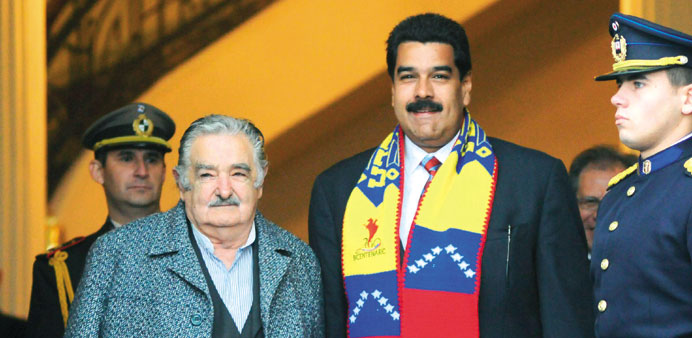
Venezuela President Nicolas Maduro (right) and his Uruguayan counterpart, Jose Mujica, at the opening of Mercosur summit in Montevideo on Friday.
Agencies/Montevideo
South American leaders had strong words for Washington on Friday over allegations of US spying in the region and defended their right to offer asylum to fugitive former US spy agency contractor Edward Snowden.
Washington wants Snowden arrested on espionage charges after he divulged extensive, secret US surveillance programs. Stuck in the transit area of Moscow’s international airport since late June, he is seeking asylum in various countries.
Capping two weeks of strained North-South relations over the Snowden saga, presidents from the Mercosur bloc of nations met in Montevideo. Complaints against the US were high on the agenda, as Washington warned the international community not to help the 30-year-old Snowden get away.
“We repudiate any action aimed at undermining the authority of countries to grant and fully implement the right of asylum,” Mercosur said in a statement at the close of Friday’s summit.
The statement called for “solidarity with the governments of Bolivia, Nicaragua and Venezuela, which have offered to grant asylum to Mr Edward Snowden.”
The Mercosur bloc comprises Venezuela, Brazil, Argentina, Uruguay and Paraguay.
“This global espionage case has shaken the conscience of the people of the US and has upset the world,” Venezuelan President Nicolas Maduro said.
The meeting began as reports emerged that Snowden wants to travel eventually to Latin America after seeking temporary asylum in Russia.
Leaders throughout Latin America are also furious over reports the US National Security Agency targeted most Latin American countries with spying programs that monitored Internet traffic, especially in Colombia, Venezuela, Brazil and Mexico.
In its statement, Mercosur said: “We emphatically reject the interception of telecommunications and espionage activities in our countries, as they are a violation of human rights and citizens’ right to privacy and information.”
It also called for the spy scandal to be brought before the UN Security Council.
The espionage allegations were published by a leading Brazilian newspaper, O Globo, on Tuesday. The US ambassador to Brazil, Thomas Shannon, said this week the reports gave an incorrect picture of US data gathering.
“This is the world we live in; a world with new forms of colonialism,” Argentine President Cristina Fernandez said in her closing remarks in Montevideo. “It is more subtle than it was two centuries ago, when they came with armies to take our silver and gold.”
Colombia, Washington’s closest military ally in Latin America, and Mexico, its top business partner, have also joined the chorus of governments seeking answers.
“Any act of espionage that violates human rights, above all the basic right to privacy, and undermines the sovereignty of nations, deserves to be condemned by any country that calls itself democratic,” Brazilian President Dilma Rousseff told reporters on arrival at the meeting.
Rousseff, who was imprisoned under military rule in Brazil in the early 1970s, said the rights issue was particularly important for South American countries that lived under dictatorships for years and are now democracies.
Despite their fiery rhetoric and public offers of asylum, few in Latin America seem particularly keen to welcome Snowden and risk damaging trade and economic ties with Washington.
Cuba and Venezuela are both in a cautious rapprochement with the US that could be jeopardized if they helped Snowden.
Still, leaders recalled that many of their own citizens sought asylum abroad during the military dictatorships of the Cold War era.
South American leaders rallied in support of Bolivian President Evo Morales last week after he said he was denied access to the airspace of Portugal, France, Italy and Spain on suspicion Snowden might be on board his plane as Morales flew home from a visit to Russia.
Bolivia is an associate member of Mercosur, and Morales attended Friday’s meeting. The Mercosur statement said bloc member countries would call their ambassadors in from the four European countries for consultations.
The South American leaders rejected “any attempt at pressure, harassment or criminalization by a state or third parties” in response to a decision to grant asylum.
They demanded “an immediate end to such practices and explanations as to their motivation and their consequences.”
They also plan to push for the adoption of Internet regulatory rules, with an emphasis on cyber-security “to guarantee the protection of communications and preserve the sovereignty of states.”
Mercosur leaders also said they would recall their ambassadors from Spain, France, Italy and Portugal for consultations in protest at the four nations’ decisions to close their airspace to the plane carrying Morales last week.
Argentine Foreign Minister Hector Timerman told the summit that more than 100 of his country’s officials were under electronic surveillance from a nation he did not name.
“I received less than an hour ago from a country present in this room the names (of the targeted officials) with their emails and passwords,” he said.
And Argentine President Cristina Kirchner said Morales’ airplane holdup raised fears that her presidential plane could be impounded over a debt dispute.
“If I am aboard, I don’t know if they won’t seize me as well,” she said. “There are new forms of colonialism, more subtle than those practiced centuries ago.”
In January, the Argentine government had to rent a British aircraft for Kirchner’s trip to Cuba, the United Arab Emirates, Indonesia and Vietnam for fear that her official plane would be impounded in a debt dispute.
Last year, a court in Ghana impounded the Argentine navy sail ship Libertad for two months following a request from a Cayman Islands-based investment firm that said Buenos Aires owed it $370mn.
Argentina, Brazil and Uruguay suspended Paraguay from Mercosur after Paraguay’s Congress impeached leftist president Fernando Lugo and removed from office in June 2012. The four countries are the founding Mercosur members.
With Paraguay gone, Argentina, Brazil and Uruguay admitted leftist Venezuela as a Mercosur member.
On Friday the bloc agreed to reinstate Paraguay’s membership once rightwing tycoon Horacio Cartes, elected president in April, takes office on August 15. Cartes however appeared to reject the offer.
Timerman said that Paraguay’s readmission “implies accepting” Venezuela’s admission to the group - a move president-elect Cartes said in a statement did not follow the proper legal procedure.
Further complicating the issue, Venezuela’s Maduro took over the trade bloc’s rotating presidency Friday from Uruguay’s president Jose Mujica.