


Reuters/London
The government has turned down a request for a public inquiry into the murder of a former Russian spy in London which could have revealed whether Moscow was behind the killing, a coroner announced yesterday.
Coroner Robert Owen had asked ministers to hold an inquiry, declaring his own investigation flawed after bowing to ministers’ requests for some material to be kept secret which could have shed light on Russia’s suspected involvement.
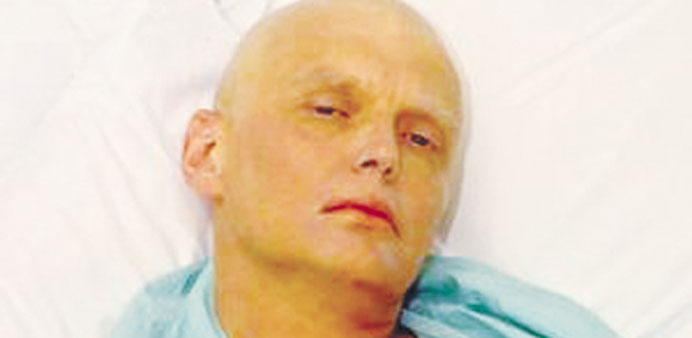
Alexander Litvinenko, 43, died in 2006 after drinking tea poisoned with a rare radioactive isotope, polonium-210, in a plush London hotel.
From his deathbed he accused Russian President Vladimir Putin of ordering his murder, a charge Russia has repeatedly denied.
Anglo-Russian relations deteriorated to a post-Cold War low after British police and prosecutors said there was enough evidence to charge two former KGB agents, Andrei Lugovoy, who denies any involvement, and Dmitry Kovtun, with murder.
Prime Minister David Cameron has made a concerted attempt to mend diplomatic and business ties since coming to power, and Litvinenko’s family have accused Britain of wanting to cover up embarrassing information to protect lucrative trade deals.
“It is a political decision of the British government,” Litvinenko’s widow Marina told reporters after the news was broken at a pre-inquest hearing at London’s High Court.
Her lawyers are now seeking a judicial review.
Under British law, inquests conducted by coroners are held when a person dies unexpectedly to determine the cause of death. The former KGB agent had been granted British citizenship and become a vocal critic of Putin. Previous pre-inquest hearings have heard he had worked for Britain’s MI6 intelligence service, and that the government held evidence which established a “prima facie case” Russia was behind his murder.
Owen, a senior judge acting as coroner, agreed in May to keep secret material which, if aired at an inquest, could undermine trust in the British government or “cause real harm to the UK’s international relations”.
He concluded the only way to learn the truth was through a public inquiry which could examine such information in private if needed. But looking visibly shocked and angry, Owen said he had been given just 45 minutes notice prior to yesterday’s announcement that the government had rejected his inquiry request.