


|
Egypt issued a warrant yesterday for the arrest of the Muslim Brotherhood’s supreme leader Mohamed Badie in connection with deadly violence in Cairo, stoking Islamist anger over the army’s ouster of president Mohamed Mursi. |
Badie and other senior Brotherhood leaders are wanted on suspicion of inciting Monday’s violence outside the Republican Guard headquarters where Mursi supporters were demanding his reinstatement, judicial sources said.
Mursi is currently being held in a “safe place, for his safety”, foreign ministry spokesman Badr Abdelatty told reporters. “He is not charged with anything up till now,” he said.
The Islamist president’s overthrow by the military last week, after nationwide protests demanding his resignation, has plunged Egypt into a vortex of violence.
More than 50 people died in Monday’s violence, most of them Mursi supporters.
The Brotherhood says troops and police “massacred” its activists as they were performing dawn prayers, with women and children among the dead.
The army said it was responding to an attack by “armed terrorists”.
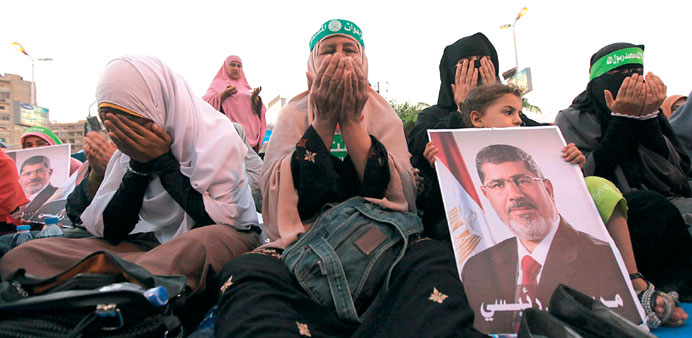
Thousands of Mursi supporters joined those camped out at the Rabaa al-Adawiya mosque in Cairo’s Nasr City for a prayer in honour of those who died, and vowed to carry on protesting until Mursi’s reinstatement.
“We are gathering here for Mursi. I voted for him and I want to know where he is,” said protester Mohamed, 47.
“We will stay here either until the president’s return or martyrdom,” he said.
According to the health ministry, 53 people died and 480 were wounded in Monday’s clashes. It denied the Brotherhood’s claim that there were women and children among the casualties.
The public prosecutor pressed charges yesterday against 200 of the 650 people it detained during the violence, judicial sources said.
The warrant for Badie’s arrest was likely to make it harder for the interim civilian administration to be formed by prime minister-designate Hazem al-Beblawi to reach out to the Islamists.
The liberal former finance minister, who began talks on his cabinet line-up yesterday, is ready to offer the Brotherhood ministerial posts, the state-run Mena news agency quoted an aide as saying.
But the Islamists spurned the overture. “We do not deal with putschists. We reject all that comes from this coup,” Brotherhood spokesman Tareq al-Mursi told AFP.
On Friday, Badie gave a fiery speech in which he vowed that Brotherhood activists would throng the streets in their millions until Mursi’s presidency was restored.
Following Monday’s bloodshed, the Brotherhood called for an “uprising”.
Interim president Adly Mansour has set a timetable for elections by early next year, while appointing Beblawi as premier and Nobel Peace laureate Mohamed ElBaradei as vice president for foreign affairs.
Opponents and supporters of Mursi alike have criticised the interim charter proposed by Mansour to replace the Islamist-drafted constitution.
The Brotherhood had already rejected the charter as a decree enforced by “putschists”, and cracks have now emerged in the loose coalition that backed Mursi’s overthrow.
An official with one of the parties in the National Salvation Front (NSF), the main coalition formerly led by ElBaradei, said Mansour’s 33-article declaration foresees new “legislative, executive and judicial powers” for the interim president.
“You would look like a hypocrite now. It makes it look as if you are not against dictatorship, just against a dictatorship that is not from your group,” the official said.
Human rights groups condemned the use of “excessive” force against Brotherhood supporters on Monday, and called for an independent investigation.
Kuwait pledged $4bn in assistance to Egypt, bringing the combined total pledged by Gulf Arab states since Mursi’s ouster to $12bn.