


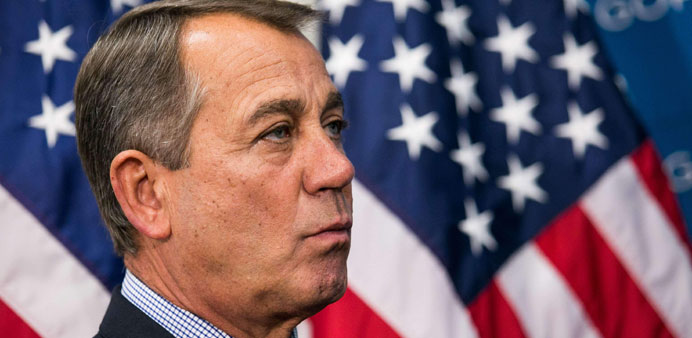
Speaker of the House John Boehner looks on during a press conference, on Capitol Hill, in Washington, DC. Boehner and the Republican leadership discussed the immigration bill and the Obama administration’s decision to delay a portion of the Affordable Care Act, which will extend the deadline for employer mandated healthcare to 2015.
Reuters/Washington
President Barack Obama jumped into the immigration debate yesterday, releasing a report touting economic benefits from reforms and meeting with Hispanic lawmakers, as House of Representatives Republicans gathered to try to craft their response.
The release of the White House report signalled a new outspokenness by Obama, who made immigration a top legislative priority but stayed on the sidelines of the debate that raged in the Senate in May and June. The report said passing reforms would grow the economy by 3.3% by 2023 and reduce the deficit by almost $850bn over 20 years.
Obama also was scheduled to meet with the Congressional Hispanic Caucus as he launches an offensive to pressure hesitant Republicans in the House of Representatives to act on comprehensive immigration legislation this year.
Meanwhile, House Speaker John Boehner invited all 233 of his fellow House Republicans in his chamber to a two-hour meeting yesterday to discuss the bipartisan Senate bill that would give legal status to around 11mn undocumented residents and eventually allow them to apply for US citizenship.
Boehner knows he will have a tough time convincing conservatives that the Senate approach is anything but amnesty for people who have broken the law after entering the US illegally or overstaying their visas.
According to one House aide, Republican leaders will listen to ideas from members on how to proceed. The main question for now, the aide said, was whether any narrow immigration bill should be put to a vote by the full House before the August recess, when lawmakers will be home, facing their constituents.
Previewing yesterday’s meeting, Boehner told reporters on Tuesday that he would pursue a “step-by-step approach” to immigration and “the first big step is you have to have a serious border security” plan.
The comprehensive Senate-passed bill contained tough security measures with $46bn in spending over 10 years to place 20,000 more agents at the US border with Mexico and buy high-tech surveillance equipment.
Nevertheless, only 14 of the Senate’s 46 Republicans voted for the bill and many House Republicans complain that the 11mn illegal residents would be mainstreamed into American society before the southwestern border is fully secured.
Last November’s presidential election, in which Obama captured more than 70% of the growing Hispanic vote, was a wake-up call to Republican leaders that their party must do more to appeal to minorities.
Former President George W Bush, who failed to pass a comprehensive immigration bill when he was in office, yesterday said that he hoped there would be a “positive resolution” to Congress’s immigration debate.
Speaking in Dallas at a naturalisation ceremony hosted by The Bush Center, the two-term Republican president did not endorse any specific bill, but said, “We have a problem. The laws governing the immigration system aren’t working ... the system is broken.”
The call for comprehensive reform resonates with some Republican senators, who have to run in statewide elections, and with some prospective Republican presidential candidates.
But it is much less of an incentive for House Republicans, many of whom fear conservative Tea Party challenges if they back a pathway to citizenship for the 11mn, a core demand of Obama and his fellow Democrats.
According to a recent study by the nonpartisan Cook Political Report, which tracks congressional races, only 24 of the 234 House Republicans represent districts that are more than 25% Hispanic.
The study found that 148 of the Republican-held districts are less than 10% Hispanic, and another 62 are between 10% and 25% Hispanic.
David Wasserman, who conducted the Cook study, said most House Republicans believe they could defeat a Democratic challenger in the general election.
“But they don’t know if they will face a Republican primary challenge if they vote for an immigration bill backed by the president,” Wasserman said.
Republican Representative Steve Scalise of Louisiana, who heads a large group of House conservatives, told reporters: “In the House, we plan on addressing border security front and center. It has got to be the main component of anything that is done on immigration.”
The House Homeland Security Committee has approved a border security bill that could be considered as a stand-alone immigration measure on the House floor.