AFP/London
The government yesterday announced plans to privatise more than half of Royal Mail, the state-run postal delivery service, following a major restructuring in recent years triggered by fierce competition from e-mail.
Business Secretary Vince Cable confirmed to parliament that the coalition government planned to “dispose of a majority stake” via a flotation on the London Stock Exchange, with 10% of Royal Mail shares handed out to its employees for free.
Royal Mail was expected to be the biggest privatisation since the unprecedented sell-offs in the 1980s such as British Gas and British Telecom.
Cable, a member of the Liberal Democrats which share power with Prime Minister David Cameron’s Conservatives, said the government would seek an initial public offering (IPO) by the end of the current financial year that ends next March.
“This is logical, it is a commercial decision designed to put Royal Mail’s future onto a long term sustainable basis,” Cable told parliament.
“It is consistent with developments elsewhere in Europe where privatised operators in Austria, Germany and Belgium produce profit margins far higher than the Royal Mail but have continued to provide high quality and expanding services.”
He argued that partial privatisation would allow Royal Mail the freedom to raise capital, continue modernising and meet booming demand for online shopping delivery.
Cable added it would also help “secure the universal postal service - the six-day-week service, at uniform and affordable prices to all 29mn addresses in the UK, which is vital to the UK economy”.
Around 150,000 staff would be eligible to get a free stake in the business under Britain’s largest employee share scheme of any major UK privatisation for almost 30 years, he said.
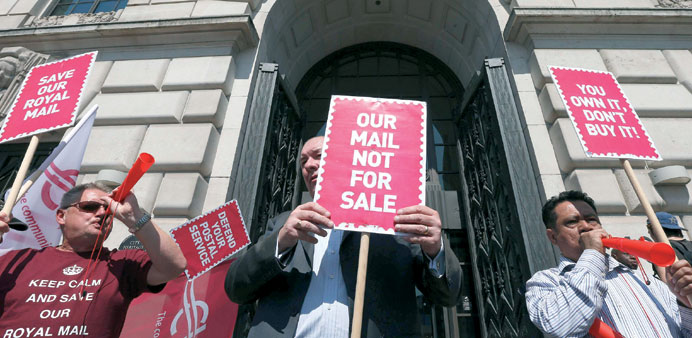
However, the Communication Workers Union (CWU) responded that it would explore strike action unless a deal on employee terms and conditions could be agreed with the eventual new owners. “I really do not understand what the government is trying to achieve by this,” said CWU deputy leader Dave Ward. “If you think about the profits the Royal Mail are now making, there’s no need for it to be privatised. What privatisation will do is destroy the UK’s universal postal service.
“There’s no way private companies can maintain six-day-a-week deliveries to every single address in the UK.”
Reports suggest that the government plans to keep a 49% holding, while Cable stressed that the government would “retain flexibility” around the size of stake to be sold.