


AFP/Sydney
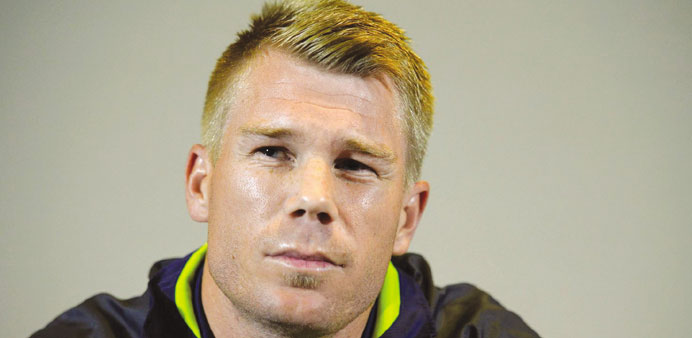
Controversial Australia batsman David Warner has been released from the Ashes squad in England to join the Australia ‘A’ side in Africa, Cricket Australia announced yesterday.
Warner was left out of the Australia side playing the first Ashes Test against England at Trent Bridge that started yesterday after completing a ban imposed for punching England’s Joe Root last month. The suspension saw Warner miss both of Australia’s warm-up matches and now team chiefs have decided he should get match practice playing for the ‘A’ side, or the national reserve side, against a Zimbabwe XI and South Africa ‘A’.
However, national selector John Inverarity said Warner remained a member of the Ashes squad and while his ‘A’ team call-up means he will miss next week’s second Test at Lord’s, he could return in time for the third of the five-match series at Old Trafford.
“David has trained hard and been very supportive of the team and his teammates during the past few weeks, but his preparation for the first Test was not ideal,” Inverarity said in a Cricket Australia statement.
“He is in need of match practice and runs in the longer format and the Australia ‘A’ games in Zimbabwe and South Africa will provide him with the best possible opportunity.”
Former Australia batsman Inverarity added: “David remains a member of the Ashes squad and will return to England at an appropriate time once we feel satisfied that he has had adequate preparation in match conditions.”
Before the first Test, new Australia coach Darren Lehmann—brought in after Mickey Arthur was sacked just 16 days ahead of the Ashes—announced that Shane Watson and Chris Rogers would open at Trent Bridge. That reduced Warner’s chances of featuring in a top order where Australia captain and star batsman Michael Clarke was assured of a place.
In the end Australia opted to play Ed Cowan and Phil Hughes at numbers three and five respectively, with
Steven Smith—a late addition to the squad as cover for Clarke, who had been suffering with a recurrence of a longstanding back injury—listed at number six.