


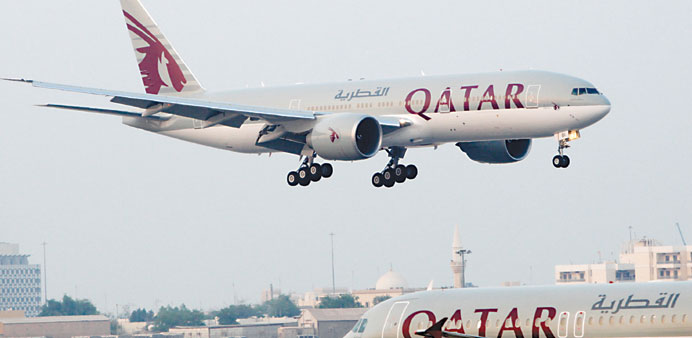
The Gulf region is dominated by the fast growth and global reach of the “Big Three” — Qatar Airways, Emirates and Etihad Airways
Middle East airlines have had the strongest year-on-year traffic growth for any region at 11.7% in May, the latest report by the International Air Transport Association (Iata) has said.
Demand for air travel in the Middle East and Africa has benefited from continued expansion in trade volumes since late 2011.
But with capacity up 12.8%, load factor declined 0.7 percentage points to 73.5%, it said.
According to Airline Leader, a global aviation journal, the Gulf region is typically dominated by the fast growth and global reach of “Big Three” - Qatar Airways, Emirates and Etihad Airways.
“The global hub model of the Big Three is now well established as the most powerful standalone new generation airline type. They are the ones with large, wide-body aircraft that can link almost any two points on the globe,” Airline Leader said.
Iata said global passenger traffic results for May showed that air travel continued to expand at a healthy rate. Growth was led by emerging markets. Compared to the year-ago period, overall demand rose 5.6%, while capacity climbed 5.2% pushing the load factor up 0.3 percentage points to 78.1%.
Demand for air travel continues to be strong despite less-than-robust economic indicators in some key markets, a further demonstration of the importance of air transport. But that importance does not carry through to the bottom line. This year, airlines are expected to make $12.7bn profits. On $711bn in revenues, that is a 1.8% net profit margin, or around $4 profit for every passenger.
Iata director general and CEO Tony Tyler said: “Global economic performance remains a concern; however, demand for air travel continues to expand. The primary driver is growing demand for connectivity to emerging markets. The business environment has also improved compared to mid-2012 with some indications of easing weakness in the eurozone. It’s still a tough environment, but there are some reasons for optimism in the second half of the year.
“The average profit per passenger is just enough to buy a sandwich in most parts of the world. Aviation will have to do much better than that in order to attract the $4bn-$5tn in capital investment that will be needed over the next 20 years to meet the demands for aviation-enabled connectivity.”
A recent Iata study supported by analysis from McKinsey & Company shows that in the 2004-11 period airline investors would have earned $17bn more annually by taking their capital and investing it in bonds and equities of similar risk.
“We need to find ways to improve returns for investors. It will require fresh thinking across the aviation value chain and from governments as well,” said Tyler.