


In Indian films, the baddies are being portrayed
as adorable men. Are we condoning villainy?
By Gautaman Bhaskaran
|
|
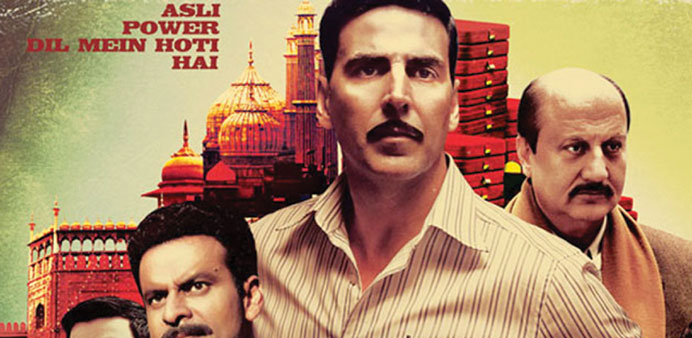
There is a disturbing aspect about Indian cinema today. It is encouraging us, even pushing us, to love the bad guy. In Neeraj Pandey’s recent film, Special 26, there are four conmen who pose as officers of the Central Bureau of Investigation (CBI) conducting raids on business houses and jewellery shops across India and decamping with money and ornaments.
Admittedly, the movie has been inspired by the actual heists which took place in the early 1980s India without mobile telephones and sophisticated surveillance gadgets.
But Pandey and his team glamourise villainy, turning the characters (played by big time actors like Akshay Kumar and Anupam Kher) into adorable men. Even Kumar’s screen lover is okay with the idea of her man being a thief! The fraudsters do not get caught, escaping the elaborate trap laid by the real CBI. The last shot shows them enjoying a cricket match at Sharjah.
The question is, would we, the audience, have been happy if the fake CBI officers were been caught and punished? Would we have wanted Kumar and Kher, masquerading in the film as epitome of sophistication, honesty and suaveness, to be outwitted by the CBI’s key player, Manoj Bajpayee’s Waseem Khan? I do not think so.
For, Pandey and his crew have so deftly created a halo around the crooks that they seem so harmless even when they slap a Minister’s private assistant or bully an elderly woman unwilling to let go her precious idol. Forget, they steal a million, perhaps beating Peter O’ Toole at his 1966 classic heist story.
I am told the fake CBI men will be back in a sequel, and with all this hullabaloo now in India around the organisation (in connection with the encounter killing of 19-year-old Ishrat Jahan), the part two will get the box office jingling all right.
However, I wonder whether the robbers will be caught this time. But this may not be quite welcome with the masses used to seeing villains being romanticised.
Here is another movie I saw last weekend, Lootera, inspired by O Henry’s short story, The Last Leaf. Here too I am sure nobody would want the lootera or the man who loots to suffer, because the helmer has scripted his plot in way that is unabashedly sympathetic to the offender.
Made by Vikramaditya Motwane, whose Udaan screened in Cannes’ A Certain Regard a few years ago, Lootera is very different in its feel and texture. True both are about troubled relationships: Udaan talks about a father’s abusive behaviour towards his sons, while Lootera explores the pining of a woman for a man she knows is not above board.
Lootera is mounted picturesquely and directed with fine imagination. Motwane captures the early 1950s Bengal in all its languid leisure, complete with a huge aristocratic mansion and royal looking Chevrolet car. Beginning with a shot of the Durga Puja (nothing can be more representative of Bengal), the film weaves us through nuanced performances of both its leads and others.
Ranveer Singh and Sonakshi Sinha are touchingly subtle in the way they express their love, and are largely restrained — keeping in tune with the times. Those were not days of explicit display of sexual emotions, no, certainly not in Bengal then. Lootera remains true to the period and place.
As the movie ambles along with long silences (what a refreshing feature used to as we are to continuous din and noise on the screen) and pregnant pauses, the scenes have a picture postcard look.
During the first half, we soak in the ethereal beauty of rural Bengal with its lush landscape. There is joy in the air, and twinkle in Paki’s (Sinha) eyes as they light up at the sight of Varun (Singh), an archaeologist who arrives from Delhi to excavate her father’s land, hoping to find a lost civilisation. He does not find that. He was not meant to in any case. He, however, loses his heart while he digs around for historic treasures.
The second half of the film takes us to Dalhousie, and by now Paki is ill, heartbroken and has lost everything. Her father is dead, shattered by betrayal of trust. (Those were such times, of course, when men believed in the goodness of men.) The canvas adapts to the Paki’s sorrow. Dalhousie is covered in sheets of snow, the skies are grey, the hill town seems desolate and unhappy – starkly contrasting with the earlier frames of blues skies, green fields, festivity, bright costumes, glittering jewels, laughter and happiness.
Into this sadness and drab existence, Varun returns not to woo Paki, but to carry out his next assignment. When they meet, Paki is so disillusioned that she refuses to let him ignite the fire all over again. It is not clear whether he wants to, and the pace here quickens to include a thriller element, a cop-and-robber chase, fights, gun battles – and Motwane falters in these sequences. His attempt to add a part of O’Henry’s story about the last leaf ends up looking contrived.
Was this the helmer’s way of infusing a little hope into our hearts? If it was so, it does achieve that. We still pine for fairy tales. So what even if the prince is a rogue. Does he not have the right to woo and win the princess? And turn over a new leaf?
This brings me back to how Indian cinema is manipulating us to love the baddie — who looks dashing and debonair.
So did Nambiar in Tamil cinema and Pran in Hindi. But the story or script never allowed them the privilege of worming their way into the heroine’s heart, and, thereby, into the view’s. In Special 26, the woman knows that her prince charming is a scoundrel. But she still loves him, runs away from the marriage arranged for her by her father and waits for her lover to appear after his last “raid”. And he does, gladdening our hearts. In Lootera, Paki would wait too.
Gautaman Bhaskaran has been writing on Indian and world cinema for over three decades, and may be e-mailed at [email protected]