


Egypt’s democratically elected president had become the face of
public anger owing to inept governance, economic mismanagement
and failure to keep the country united. As the protests against him
intensified across the country, the army stepped in. Here is the
summary of events that led to the ouster of Mohamed Mursi.
By Yasmine Saleh & Paul Taylor
|
|
For Egypt’s military chiefs, the final spur to rebellion came on June 26. That day top generals met Mohamed Mursi, the country’s first democratically elected president, and spoke bluntly, telling the Islamist leader what he should say in a major speech he planned as protests against him intensified around the country.
“We told him it has to be short, respond to opposition demands to form a coalition government, amend the constitution and set a timeframe for the two actions,” an officer present in the room told Reuters. “Yet he came out with a very long speech that said nothing. That is when we knew he had no intention of fixing the situation, and we had to prepare for Plan B.”
The officer added: “We had prepared for all scenarios, from street violence to mass clashes, and had troops ready to handle both situations.” Like other serving officers interviewed for this report, the person requested anonymity because of the sensitivity of the situation.
As tensions rose over the following days, Mursi remained defiant. In a final telephone conversation with armed forces commander General Abdel Fattah al-Sisi, the president laughed and made light of mass demonstrations against him, a military source said.
“He just didn’t believe what was going on,” the source familiar with Sisi’s contacts said. Any hope that the bearded, bespectacled Mursi would call a referendum on his own future or go quietly, had evaporated.
Soon afterwards, as millions took to the streets, the military executed their plan, confining Mursi as a prisoner in his own Republican Guard compound, arresting key supporters in his Muslim Brotherhood and seizing control of parts of the media. Thus ended the first attempt to graft political Islam and democracy onto the Arab world’s most populous and historically powerful state, two and a half years after a popular uprising ousted veteran autocrat Hosni Mubarak.
The ease and abruptness of Mursi’s overthrow underlines the fragility of the Arab Spring that toppled a string of Middle East autocrats. Hopes that popular rebellions might lead to democracy taking root remain largely unfulfilled, although the experiment is still in progress in Tunisia.
Mursi’s downfall in Egypt, a strategic hinge between the Middle East and North Africa, makes plain the fractured nature of the region and the lack of institutional depth to sustain democracy when the tides of popular opinion change. The result in Egypt and elsewhere are deep divisions and instability.
Mursi’s ouster has also renewed the debate around whether democracy and political Islam can co-exist. The Muslim Brotherhood’s first taste of power lasted little more than a year. Muslim Brotherhood members in Egypt point to the irony of the West encouraging democracy but quietly supporting a military coup, even if few Western leaders are calling it that.
The military’s move has also further exposed the many ways in which the Muslim Brotherhood struggled to govern. Egyptians and investors alike complained that some ministries had descended into chaos, with key positions filled by Muslim Brotherhood stalwarts who knew little of the workings of a modern economy. The Egyptian stock market rallied the day after Mursi’s overthrow.
Mursi’s own shortcomings were stark, and stand in contrast to the way someone like Nelson Mandela, ailing at the other end of the continent, came to power with a message of unity and forgiveness.
Security risk
A provincial engineering professor, Mursi was not a natural political leader. He had become the Muslim Brotherhood’s presidential candidate only when the party’s first choice was disqualified. Nevertheless, the novice president appeared decisive on taking office, practising a winner-takes-all interpretation of power that alienated a wide swathe of secular and Islamic opponents.
Soon after he was elected in June 2012 with 51.7% of the vote, Mursi ordered Egypt’s two top generals to retire; one was Field Marshall Hussein Tantawi, a veteran who had served Mubarak for 20 years. It seemed a significant break with the past.
Mursi’s choice as the new head of the army was General Sisi, 58, a career infantry officer who had been groomed for a top role with spells as a field commander, studies at a US war college and a stint as a military attache in Saudi Arabia.
Sisi was also a devout Muslim and seemed a good fit with Mursi and his Muslim Brotherhood sponsors, who wanted the military to take a back seat after decades of being the real power.
But relations between Mursi and his new generals deteriorated within months of his inauguration. Even Mursi’s apparent success in brokering a ceasefire between Israel and the Hamas Islamist movement that runs the Gaza Strip irked the military.
“Mursi’s intervention in the Gaza war made Egypt guarantee that Hamas would not carry out attacks on Israel. Which threatens Egyptian national security, because what if Hamas did? It could prompt Israel to retaliate against us,” the security source said.
Mursi also talked loosely about possible Egyptian participation in a jihad to overthrow Syria’s President Bashar al-Assad, and raised the prospect of military action over a Nile River dam in Ethiopia. As a result, distrust of him grew in Egypt’s high command, which saw him as recklessly risking their involvement in conflicts without properly consulting and respecting the generals.
“It reached a point where we began to be worried about putting important national security reports in front of someone we perceived as a threat to national security,” the security source said.
The generals became equally alarmed about political and sectarian polarisation in Egypt, against a backdrop of a sharply worsening economy. They had secured their own position in an Islamist-tinged constitution rammed through by Mursi’s allies last December, ensuring they would remain a state within a state, with limited parliamentary scrutiny of their economic privileges, armaments contracts and control of the vital Suez Canal. But they were increasingly concerned by what they saw as a risk of civil war.
By the time Mursi took office, Egypt’s economy, which had boomed for the rich with scant improvement for the poor in the late Mubarak years, was already in deep trouble. The military council which ruled in the 16-month transition from Mubarak’s overthrow to Mursi’s inauguration had failed to carry out long-overdue reforms of food and fuel subsidies or to negotiate a loan deal with the International Monetary Fund for fear of sparking unrest. Tourism and investment had dried up because of political instability.
Mursi’s bumbling, do-little administration only made things worse. While the Muslim Brotherhood remained the most powerful political force and ran a social welfare network that provided services to the poor and needy, millions of Egyptians felt no one was representing their interests.
Referendum rejection
Youth activists of the Tamarud - Rebel! movement launched a petition on May 1 demanding Mursi’s resignation; it snowballed, receiving what they say were more than 22mn signatures. They called for nationwide protests on June 30, the first anniversary of his inauguration.
Angered by the Muslim Brotherhood’s perceived power-grabbing and economic incompetence, Egyptians turned out in their millions to shout “Erhal!” (Get out!). Counter-demonstrations by Mursi’s supporters drew a few hundred thousand people but were clearly outnumbered by the malcontents.
The day after the June 30 protests, the Army issued a 48-hour ultimatum to Mursi: either yield to the protesters’ demands that he share power with the opposition, or make way for the military to impose a solution. In two private meetings with the president on July 1 and 2, the armed forces chief was even more blunt with the president, but met with incomprehension and rejection, a military source briefed on the meetings said.
“General Sisi went to him and told us when he came back, ‘He was in denial, he said the protesters are just 130,000 to 160,000, but I told him ‘No, sir, they are far more than that and you must listen to their demands”, the source said.
“In the second meeting, General Sisi went with a video recording of the protests the army had made and told him ‘Sir, the situation is out of hand and your suggestions to change the government or the constitution are now too late and will not satisfy the street. I suggest you call a referendum on your continued rule.’ But he refused and said this is unconstitutional and illegitimate,” the source said.
Faced with the president’s refusal, Sisi intensified contacts with Mohamed ElBaradei, the senior liberal politician nominated by the National Salvation Front (NSF) opposition coalition as their negotiator with the army, and with the country’s revered Muslim and Christian leaders, Grand Sheikh Ahmed al-Tayeb of the al-Azhar Islamic institute and Pope Tawadros of the Coptic Church. Both had publicly blessed the protest movement.
The army chief also made the savvy move of including the young founders of Tamarud — Rebel! and a leader of the second largest Islamist party, the ultra-conservative Salafist Nour party, an open rival of the Brotherhood.
They all met at the headquarters of military intelligence on El-Thawra (Revolution) Street on Wednesday, July 3 — the day the ultimatum was set to expire — to thrash out a roadmap for the country’s second attempt at a transition to democracy. The meeting lasted about six hours, short by Egyptian standards. The army effectively adopted the blueprint put forward by Tamarud and endorsed by the NSF.
“General Sisi tried to contact the Muslim Brotherhood leader to suggest a referendum option, but he along with others refused to come,” the military source said. “He also offered it to the politicians and others, but Tamarud members refused it, and the others agreed to almost everything Tamarud suggested.”
The 20-something activists who controlled the street were calling the shots.
Foreign advice
Outsiders were also concerned, not least because Egypt receives significant US aid and Mursi represented a rare beacon of democracy in the region. US President Barack Obama, on a visit to Tanzania, telephoned Mursi on Monday July 1 and urged him to respond to the demands of the protesters, the White House said.
John Kerry, US Secretary of State, told reporters while travelling in the Middle East last week: “We have made many recommendations to our friends in Egypt. We are trying to help, as other countries are trying to help, to create a place for the opposition to be part of the political process in order to create some economic reforms that will help attract business and capital and begin to move their economy.”
Yet senior US officials doubted Mursi’s ability to unite the country and resolve the looming crisis.
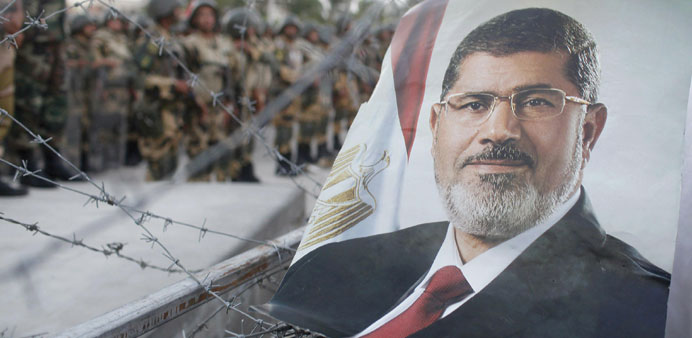
* A portrait of former Egyptian president Mohamed Mursi is seen near a Republican Guard building in Cairo.