


|
|
Indian stocks advanced as the rupee rebounded from a record low after regulators took steps to curb speculation in the derivatives market.
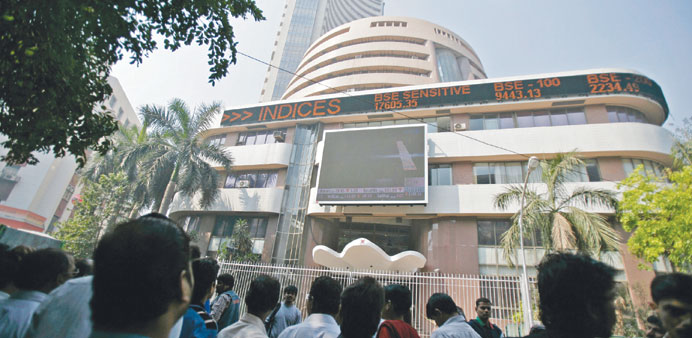
The S&P BSE Sensex rose 0.6% 19,439.48 at the close in Mumbai, with volume 21% below the 30-day average. Sun Pharmaceutical Industries, the nation’s largest drugmaker by market value, rallied to a record. State Bank of India rose for the first time in three days, leading lenders higher. The rupee strengthened as much as 1.5%.
The currency slid to an unprecedented 61.2125 per dollar on Monday on concern the US will cut stimulus that spurred inflows to emerging markets. A weaker rupee stokes inflation by raising the cost of India’s imported oil, limiting the central bank’s ability to cut interest rates, and threatens to increase costs for companies facing at least $20bn in foreign debt repayments in the coming year.
“The market is drawing comfort from the fact that the Reserve Bank of India will not let the rupee slip below 61,” Gajendra Nagpal, chief executive officer at Unicon Financial Intermediaries, said by phone from New Delhi. “If foreign investors get the feeling that the regulators will support the rupee at 61 then they will start deploying funds. So far, they have been on the sidelines as they had not seen a strong signal from the RBI about supporting the currency.”
The Sensex has dropped 3.1% since May 22, when Fed Chairman Ben Bernanke said the central bank will slow stimulus if the US economy shows sustainable improvement. That spurred global funds to sell emerging-market assets. Foreign investors pulled a net $1.76bn of local shares in June, the highest since August 2011, data from the regulator show. They sold a net $39mn of shares on June 8, the data show.
The rupee gained 0.8% to 60.1450 at the close after the central bank barred lenders from proprietary trading in currency futures and exchange-traded options. The Securities and Exchange Board of India said yesterday it will increase margin requirements and curtail open positions from July 11.
The rupee weakened 4.9% in June, the most since May 2012. A weak currency increases profits at exporters, including pharmaceutical companies and technology companies, as the value of their expatriated earnings increases.
One-month implied volatility, a measure of expected moves in the exchange rate used to price options, fell 34 basis points, or 0.34 percentage point, to 13.21%.
Three-month onshore rupee forwards jumped 0.9% to 61.28 per dollar, according to data compiled by Bloomberg. Offshore non-deliverable contracts rose 0.9% to 61.40.
In stocks, Sun Pharmaceutical jumped 3.6% to Rs1,079.7, an all-time high. Dr Reddy’s Laboratories increased 1.6% to Rs2,284.2 and Ranbaxy Laboratories rose 1.8% to Rs348.95. Infosys, India’s second-biggest software exporter by value, gained 1.2% to Rs2,498.2. Wipro, the third-biggest, climbed for the fourth day, gaining 1.3% to Rs360.15.
State Bank climbed 1.2% to Rs1,894.65, ending two days of decline. HDFC Bank, India’s biggest lender by value, climbed 1.5% to Rs670.3. Axis Bank rose 0.9% to Rs1,264.35.
The Sensex has gained 0.1% this year and trades at 13 times projected 12-month earnings, compared with the MSCI Emerging Markets Index’s 9.6 times. The Indian index’s 50-day volatility measure, a gauge of price swings, climbed to 18.5 on Monday, the highest reading since April 2012.
The CNX Nifty Index on the National Stock Exchange of India increased 0.8% to 5,859.
“The tightening of derivative trading, coupled with potential measures to curtail the impact of oil-related dollar demand, could provide a reprieve to the rupee,” Irene Cheung, a Singapore-based strategist with ANZ Banking Group, wrote in a research report today. “That said, we continue to see the rupee under severe pressure, as Fed quantitative-easing tapering could continue to trigger capital outflows from India.”
India’s central bank, concerned about the fastest growth in currency derivatives trading in more than three years, asked overseas funds on June 26 to prove they aren’t speculating on the exchange rate.
Turnover in futures and options involving the rupee climbed 47% to a daily average of Rs387.7bn ($6.4bn) in June on the National Stock Exchange of India, the biggest jump since January 2010. The central bank has also enquired about foreign lenders’ open positions involving the rupee. Global investors can use rupee derivatives in the over- the-counter market only to protect their holdings of Indian shares and debt.
The RBI and state refiners including Indian Oil Corp are exploring the possibility of mandating a single state-run bank to sell dollars to the firms, eliminating bids that fuel currency speculation, the oil ministry official said, asking not to be identified because the information isn’t public.
Commonwealth Bank of Australia is looking to sell the Indian currency on bouts of strength as it doesn’t “see speculation as being the only woe that the rupee faces,” Singapore-based strategist Andy Ji said. “I don’t see the current-account deficit narrowing any time soon, and concerns remain with much below-trend growth.”
India’s current-account gap increased to an all-time high 4.8% of gross domestic product in the year ended March 31, official data show.
ANZ will also look to sell the rupee in the offshore market when the three-month rupee contracts gain to around 60 per dollar, according to yesterday’s report.
The rupee will drop to 62 per dollar by end-2013, according to Nomura Holdings, the most accurate forecaster for the currency in the last four quarters, according to data compiled by Bloomberg. Second-ranked JPMorgan Chase & Co shares that forecast, while No 3, Canadian Imperial Bank of Commerce, predicts 61.50.
Carry traders, who borrow in a low-yield currency to buy one with higher rates, lost 6% on rupee investments using dollars since the start of June, the worst performance among 11 Asian currencies, after earning 0.8% this year through May 31, data compiled by Bloomberg show.
Global funds cut holdings of rupee debt by $1.1bn this month through July 5, following a record $5.4bn withdrawal in June, exchange data show.