


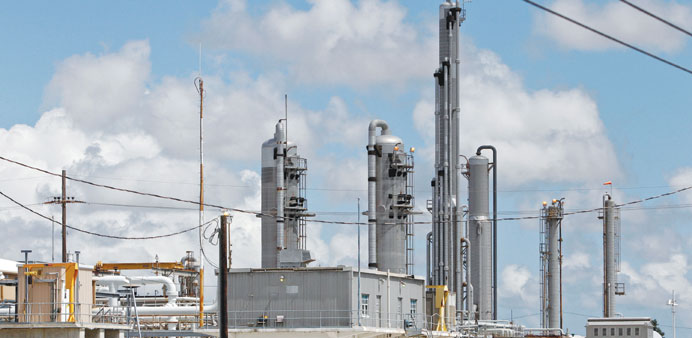
A gas processing facility operated by Enterprise Products Partners stands in Yscloskey, Louisiana, US (file). New pipelines are boosting the amount of gas liquids brought out of the shale regions in the US.
Bloomberg/New York
The US natural gas surplus that drove prices below $2 last year for the first time in a decade is poised to return, threatening the forecasts of everyone from Bank of America Corp to Deutsche Bank AG.
Prices have dropped 17% from a 21-month high on May 1, slipping to within less than 3¢ of $3.50 per million British thermal units at the end of June, as rising production swelled stockpiles. Bank of America said on July 3 gas will trade in a range of $3.50 to $4 this quarter. Deutsche Bank predicted June 25 prices will average $3.80 during the period.
Gas from wells drilled to produce crude and other liquids, known as associated gas, is underpinning output growth, according to International Strategy & Investment Group in New York. Supplies may rise by 1bn cu ft a day in 2013, or about 1.4%, while demand from power generators drops as plants switch to cheaper coal, ISI said.
“Associated gas is powerful and it’s driving production growth,” Jonathan Wolff, a senior managing director at ISI in New York and former head of global energy research at Credit Suisse Group, said in a phone interview. “The lost demand from gas-to-coal switching is a headwind, so prices need to fall in order to win that share back.”
Natural gas for August delivery declined 2% to $3.617 on July 5 on the New York Mercantile Exchange. Prices dropped 11% in the three months ended June 30, the first quarterly decline since March 2012. The futures rose to $4.444 on May 1, the highest intraday price since July 25, 2011.
Goldman Sachs Group cut its forecasts for the third and fourth quarter by 14% and 6%, respectively, as supplies increase, the bank said in a July 7 report. Futures will average $3.85 this quarter and $4.25 from October through December, Goldman said.
Hedge funds cut bullish natural gas bets to a three-month low at the end of June as mild weather curbed demand and spurred above-average stockpile gains.
Money managers reduced net-long positions, or wagers on rising prices, by 5.5% to 321,673 futures equivalents in the seven days ended June 25, according to the Commodity Futures Trading Commission’s June 28 Commitments of Traders report. It was the lowest level since the week ended March 12.
Gas tumbled to $1.902 in April of 2012, the lowest price since January 2002, after the supply surplus ballooned to 61% above the five-year average. Inventories were 1.1% below average levels at the end of June this year, the narrowest deficit since March, when falling temperatures stoked heating demand and eliminated the glut, which had persisted since September 2011.
Associated gas accounted for 51% of US production in 2012, up from 49% the previous year, the International Energy Agency said June 20 in its Medium-Term Market Report. The percentage may rise to 54% by 2014, the Paris-based organisation said.
The output exceeded supplies from dry gas formations, which don’t yield oil and gas liquids such as ethane and propane, over the past two years, the IEA said. More than 80% of production growth from 2012 through 2017 may be from the US Northeast, home to the Marcellus shale deposit.
“US gas production increased in 2012 because many companies concentrated their drilling activities on tight oil plays with associated gas production, thus reaching higher production rates per well,” the IEA said.
Gas output may rise 1.2% this year to a third straight annual record after gaining 5.3% in 2012 and 7.4% in 2011, according to the US Energy Department’s Energy Information Administration.
“Producers are putting holes in the ground for crude oil and getting residual natural gas,” Bob Yawger, director of the futures division at Mizuho Securities USA Inc in New York, said in a June 25 phone interview. “That’s perpetuating the abundance of supply. The associated gas is going to be the wave of the future for this market.”
A “bonanza” of new pipelines and processing plants near shale formations including the Marcellus, the Eagle Ford in Texas and the Utica in Ohio will bring more supply to market, Credit Suisse said in a June 25 report to clients. Pipeline capacity in the Marcellus may increase by more than 3bn cu ft a day, the bank said.
New pipelines are boosting the amount of gas liquids brought out of the shale regions. Sunoco Logistics’ Mariner East pipeline, scheduled to begin operations next year, would deliver propane and ethane from the Marcellus to Marcus Hook, Pennsylvania, where the fuel will be processed, stored and shipped to other markets. Enterprise Products Partners’ 1,230-mile (1,979km), Appalachia-to-Texas pipeline will carry ethane from the Marcellus to the Gulf of Mexico starting in the first quarter of 2014.
“We remain persuaded that the supply side’s ample and easy-to-accelerate growth should keep a lid on prices,” Jan Stuart, head of energy research at Credit Suisse in New York, said in the report.
Gas’ share of demand from electricity generators may decline in 2013 with prices up 23% from a year ago. The fuel may account for 28% of power production in 2013, down from 30% last year, according to the EIA. Coal’s portion may climb to 40% from 37%, it said.
Gas consumption in the power industry may drop 9.9% this year to 22.49bn cu ft a day from a record 24.96bn last year, the agency said.
Power plants fuelled by natural gas in the 13-state region run by PJM Interconnection produced 50,153 gigawatt-hours of electricity from January through May, down 17% from a year earlier, according to a report released June 21 by the grid’s independent market monitor.
PJM’s territory, which stretches from New Jersey into North Carolina and Illinois, has 32 interstate gas pipelines, the most of any organised electricity-market region.
Coal-fired generation increased 12% to 140,718.4 gigawatt-hours, according to the report. Gas-fired power plants accounted for 16% of the total power produced during the first five months of this year versus 44% for coal.