By Noimot Olayiwola
Staff Reporter
Living plants called ‘Lightweeds’ that attempt to restore the natural timeline that a space has walled out, are among the creative works being featured under the theme: “The Garden of Contemplation” at the exhibitions recently launched at the new Katara Art Studios.

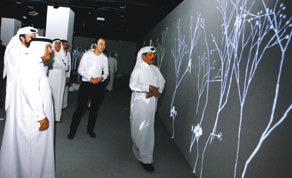
Minister of Culture, Arts and Heritage HE Dr Hamad bin Abdulaziz al-Kuwari viewing the plants while Sheikh Faisal bin Qassim al-Thani and Heijdens (second right) and others look on
Lightweeds are living digital organism growing on the walls and floors of an indoor space, that reacts to the actual nature of its location and reveals the character of a space. The projected plant silhouettes are alive from a digital seed that contains the genetical data of its family, they grow affected by the actual measured rainfall and sunshine, move directly on actual wind, and throughout the day turn along with the sun.
“This work started in 2004-2005 from the idea of how we are spending more and more time in the artificial spaces where the unplanned or coincidental timeline of everyday is pushed away by air-conditioning or 24 hour lighting and when you are inside a building, it could be day or night and it is always perpetual and it is still becoming more and more perpetual,” Lightweeds artist Simon Heijdens explained.
He maintained that showcasing the new kind of art work in Qatar demonstrated the common features between his country - the Netherlands - and Qatar.
“What this kind of art work portends is something that Qatar and the Netherlands have in common, although in different ways, as both countries have the artificial and regimented structured society as well as landscape,” he stated.
According to Heijdens, the idea of the work was also to try to bring back the lost timeline of nature.
“This exhibition is not just about the drawings and the plants are not pre-drawn or animated, but uniquely generated by a software and the space they reside in. A lightweed consists of several hundred parts that are independently linked to the sensors outside, creating a live and hyper-real motion,” he said.
He said that the sensors are placed on top of the building housing the plants in order to measure the wind and sunlight as well as the position and intensity of the sun in addition to measuring the humidity and rainfall.
“The sensor sends data to the computers of the artworks inside and the software, which is the actual work, takes the daytime to generate plants from the weather. The plants that grow up will always be an individual like character because they move quietly due to the sensor and the plants become very eventful and tense if it is winding outside,” Heijdens added.
He said that at the start of the day, the plants could be very few, but as the space is being used they pollinate from wall to wall and increase in amount.
“Because their seeds travel along with the direction of passing people and make new plants grow on places towards where there is more traffic, they reveal the way the space is being used. Because the way the plants grow, behave, pollinate and die is completely defined by the space, they make up continuously evolving combinations that are never equal,” Heijdens added.
He has done four-five exhibitions using the software, which took him two years to develop, to generate indoor plants.
“Some of the past exhibitions I have had are site-specifics, while some are temporary and others are permanent like the Museum of Modern Arts in New York, which has acquired the work for their gallery,” he mentioned.