


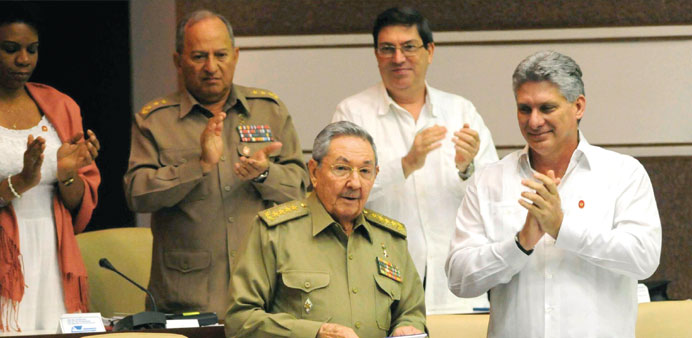
Cuban President Raul Castro and Cuban First Vice-President Miguel Diaz-Canel (right) attend the first annual session of the National Assembly at the Conventions Palace in Havana on Sunday.
AFP/Havana
Fugitive US intelligence leaker Edward Snowden won support from Cuba for his bid to seek asylum in Latin America as he began his third week in limbo yesterday at a Moscow airport.
Cuba, a key transit point from Russia on the way to Latin America, supported the leaders of Bolivia, Venezuela and Nicaragua, who have offered the 30-year-old a possible lifeline as he remains marooned without documents in the transit area of a Moscow airport.
“We support the sovereign rights of the Bolivarian Republic of Venezuela and all the regional states to grant asylum to those who are being persecuted for their ideals or their fight for democratic rights, in accordance with our traditions,” Cuban leader Raul Castro said on Sunday.
Speaking to Cuba’s national assembly, Castro did not say whether his country, which has been showing signs of mending ties with Washington, would itself offer refuge to Snowden.
“If Raul Castro’s solidarity on #Snowden is serious, Cuba will publicly offer Snowden asylum,” anti-secrecy organisation WikiLeaks said on Twitter.
Multiple obstacles continue to cloud the former National Security Agency contractor’s asylum hopes however and it remains unclear how he would be able to leave Russia, even if granted asylum by the three Latin American countries.
The Nicaraguan embassy in Moscow yesterday confirmed it had received Snowden’s asylum application, but stressed it had not yet made any contact with the American.
“We received a letter from Snowden,” the Nicaraguan ambassador in Moscow, Luis Alberto Molina, told the Russian state news agency ITAR-Tass. “We forwarded it to Nicaragua so that the president can consider it.”
The embassies of Bolivia and Venezuela said they were unaware of any developments that would help Snowden leave Sheremetyevo Airport.
The Kremlin yesterday reiterated it wanted to keep the Snowden affair at arm’s length, declining to say how he could leave without a valid passport.
“That’s not our business,” President Vladimir Putin’s spokesman Dmitry Peskov told AFP. “We are not saying anything.”
Snowden, who is seeking to evade US justice for leaking explosive details about a vast US electronic surveillance programme, caught the Kremlin off guard when he arrived in Russia from Hong Kong on June 23.
After the US revoked his passport, Snowden, who has applied for asylum in 27 countries, has been unable to leave the Sheremetyevo transit zone.
The only flight for which Snowden was known to have been checked-in - a 12-hour Aeroflot flight to Havana - left on June 24 without the fugitive on board but with several dozen journalists in tow.
The Kremlin has been forced to perform a tough balancing act, saying it would not expel the US national but also stressing it did not want to damage ties with Washington ahead of Putin’s summit with US leader Barack Obama in early September.
The Kommersant daily, citing a source close to the US State Department, said yesterday Obama was unlikely to come to Moscow if Snowden was still stuck in the airport.
Peskov dismissed the report as “speculation”, and in Washington, National Security Council spokeswoman Bernadette Meehan also said the report was false.
“President Obama intends to travel to Russia in September,” Meehan said.
Even if Snowden receives a new passport or travel document and manages to board a flight to Latin America, there are no guarantees that his plane would not be grounded once it reaches European airspace, analysts say.
Putin said Snowden could remain in Russia as long as he stopped his leaks, a condition the Kremlin later said the American was not willing to honour.
“Bolivia and Venezuela, with their unstable governments, cannot guarantee him anything,” said security analyst Pavel Felgenhauer.
He said Snowden was increasingly vulnerable to pressure from Russian special services, which he said may strong-arm him into remaining in Russia and cooperating.
Bolivia seeks answers from Europe in plane spat
Bolivia yesterday demanded France, Portugal, Spain and Italy reveal who told them that former US spy agency contractor Edward Snowden was aboard President Evo Morale’s flight from Moscow last week.
Bolivia said it was an act of “state terrorism” by the US and its European allies that the four countries banned Morales’ plane from their airspace on suspicions it was carrying the US fugitive to Bolivia in defiance of Washington.
The government in La Paz told the European ambassadors yesterday to provide formal explanations to the Foreign Ministry.
“We are simply asking the government of Spain and the other governments, of course, to clarify and explain where that version of Mr Snowden being on the presidential plane came from,” Communications Minister Amanda Davila said. “Who spread that fallacy, that lie?”
“As experts in international law and human rights have said, this is a massive attack,” she said. “It’s the first case of state terrorism against a president, against a nation, against a people. That’s what we’re talking about now.”
The Bolivian government believes the US knew that Snowden was not on Morales’ plane and simply wanted to intimidate Morales because of his outspoken criticism of US policies.
“We consider that the US knew that Mr Snowden was not on that plane because there is no way President Morales could leave the Moscow airport without the surveillance and checks that are always done for official flights,” Davila said.