


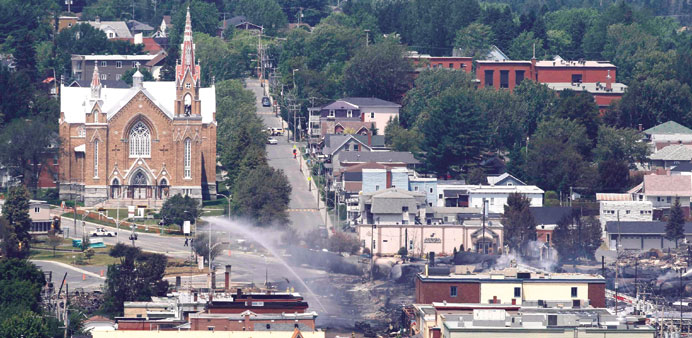
A view of the town from a lookout point at Lac-Megantic, Quebec, where an oil-laden runaway train derailed and exploded on Saturday.
Reuters/Lac-Megantic, Quebec
At least five people died and 40 were missing yesterday after a runaway train carrying crude oil exploded and destroyed the centre of a small Canadian town in a disaster that raises fresh questions about shipping oil by rail.
The train had been hauling crude from North Dakota to eastern Canada, and was parked, without a driver, outside town when it began rolling downhill, gathering speed and derailing on a curve at 1am (0500 GMT) on Saturday.
Each tanker carried 30,000 gallons (113,000 litres) of crude oil. Four cars caught fire and exploded in a huge orange and black fireball that mushroomed hundreds of feet into the air and flattened dozens of buildings, including a popular bar.
Police said were investigating the disaster, and would talk to everyone involved.
“Every time the Surete (Quebec police) needs to investigate, we need to rule out any foul play,” spokesman Benoit Richard told reporters. “Right now we cannot say it is a criminal act. We can only say we are looking at it as if it was.”
Shipping oil on rail cars has skyrocketed in the past year as crude producers seek alternatives to pipelines that are already full to capacity. Previous accidents led to messy spills rather than life-threatening explosions.
Brunet said about 40 people were missing after the derailment early on Saturday. “There could be more, there could be less,” he said.
Very few injured people were treated in hospitals, indicating those caught in the blast had either escaped or died. “It is a black-and-white situation,” Quebec Health Minister Rejean Hebert told reporters.
It is not clear why the train began rolling down toward the town, or why the crude oil, not normally considered highly explosive, blew up. The rail line is owned by Montreal, Maine & Atlantic, which said the engineer had secured the train for the night and left.
“That’s the first thing I would think of: did someone release all the brakes?” asked Guy Landrio, a Warren, Pennsylvania, railroad consultant with 37 years of industry experience. “In my experience, a train doesn’t just simply let itself go down the hill into a town. There’s usually a cause behind it.”
Genevieve Guilbault, spokeswoman for the coroner’s office, said the dead were burned beyond recognition and that DNA and dental records would likely need to be used for identification.
“Given the size and intensity of the blast, you can imagine the condition of the bodies,” she told reporters.
White vapour still rose yesterday from the town centre, which police have cordoned off. Photos showed shattered buildings, burning piles of rubble and stumps of burned trees.
Residents said they were particularly concerned about people who had been inside the Musi-Cafe bar, which was right next to the center of the blast.
Yvon Rosa said he and a friend had just left the Musi-Cafe when they saw the train hurtling toward them. As the town center exploded, they ran to the lake, jumped in a boat and went out onto the water until morning.
“It was incredible. The smoke, the heat - fire everywhere. There were people running... It was like the apocalypse,” he said.
About 2,000 of the town’s inhabitants were evacuated after the blast, scores at them to a school transformed into a shelter.
Outside the building, Louise Boulet, 65, looked at a local newspaper that had published an aerial view of downtown. One of the flattened buildings was the house where her 63-year old sister, Marie-France Boulet, lived.
“She is dead for sure. If she were alive, her car would not still be there,” Louise said, pointing to a burned-out vehicle in the photo.
Marie-France ran a women’s clothing shop from the front of the building where she lived by herself.
“She was my best friend,” Louise said as tears welled in her eyes. “She died with all of my secrets and I will guard all of hers.”
Lac-Megantic, a town of 6,000 on the edge of a deep blue lake and ringed by forests of pine and birch, is in the predominantly French-speaking province of Quebec, about 160 miles (255km) east of Montreal and close to the border with Maine and Vermont.
About 150 firefighters, some from the US, spent most of Saturday spraying cold water from the lake on five tanker cars they said still posed a serious risk of exploding.
Fire officials said yesterday they had contained the risk somewhat, and only two tankers were still considered at risk of blowing up.
Charred buildings, blackened bodies amid debris
AFP/Lac-Megantic, Quebec
Blackened buildings and bodies burned into charred debris are all that remain at the heart of the small Quebec town where an oil-laden runaway train derailed and exploded a day ago.
“All we’ll find will be their teeth,” lamented one firefighter mobilised to battle the inferno that erupted, of the scores of people still reportedly missing.
Four bodies were found Sunday morning, bringing the official death toll from the disaster to five.
At a press conference announcing the discovery of two of the bodies, police said even the gender of the victims was unidentifiable from the charred remains.
Firefighters are still working to douse blazes in at least two of the train cars that crashed, delaying search operations in downtown Lac-Megantic, where the spectacular crash saw flames shoot into the sky around 1:20am (0520 GMT) on Saturday.
Witnesses reported up to six explosions after the train derailed, and some 2,000 people were evacuated from their homes.
The train - 72 tanker cars loaded with crude oil pulled and pushed by five locomotives - left Montreal, 250km to the west, and was heading to the port of St. John on Canada’s Atlantic coast.
Instead, its final destination was this picturesque resort town of 6,000 residents in a corner of the Appalachia mountains near the border with the US state of Maine.
In this region of thick forests, the sky is normally so clear that US astronomers use the local observatory to peer into the sky.
The town’s history has been intimately linked to the rail line since settlers streamed out of train cars in the 19th century as they settled the region.
The town’s motto is “from the railway to the Milky Way,” said Remi Tremblay, the top editor of L’Echo de Frontenac, the local newspaper.
“I could show you. This motto was on the flags that decorate the main road... but they must have melted,” he said.
Tremblay was one of the thousands forced to leave his home, which was near the 2-sq km (0.8-sq mile) area consumed by flames.
In the past years rail traffic has increased significantly. “There were more freight trains - it was cause for concern,” he said.
Dressed in heavy yellow protective gear, the town fire department chief, Denis Lauzon, said that his department wanted information on what was being moved by rail through his town. “But we had yet to present a formal request,” Lauzon said.
“A wall of fire”Shocked by the force of the accident, residents pressed against police barricades seeking even the smallest detail that could help them cope with the disaster.
Rumours of the runaway “ghost train” quickly spread. “It had no driver, it was a unmanned train,” a young man told his friends gathered in front of a small grocery store ironically named “Point of Aid.”
Returning from an evening of playing bingo in a town just north of Lac-Megantic, Antoinette Paree, 78, remembers seeing “a glimmer, a sort of fire” on the train as it made its way through the night.
Paree arrived home and was looking out from her window, which overlooks the track, when she said she heard “a loud bang - it lit up the whole house,” she said.
Paree ran out to save her life, forgetting her dentures.
The cause of the crash was still unknown, but a spokesman for the Montreal Maine & Atlantic company, Christophe Journet, told AFP the train had been stopped in the neighbouring town of Nantes, around 13km west of Lac-Megantic, for a crew changeover.
For an unknown reason, Journet said, the train “started to advance, to move down the slope leading to Lac-Megantic,” even though the brakes were engaged.
As a result, “there was no conductor on board” when the train crashed, he said.
Residents gathered on the far shore of Lake Megantic around a large illuminated cross that dominates the view. There, overnight Saturday into Sunday, they watched much of their town go up in flames.
Linda Rodriguez followed the movement of the flames with her binoculars. “That’s the pharmacy, our home is 50m away on the other side of the road,” she said.
Another resident, Mariette Savoie, feared the death toll from the “wall of fire” that engulfed her town will be unbearably high.
“Above all the Main Street shops, were homes,” she said.
“All those people who were there were unable to get out.”