


By Jaime Pilapil/Manila Times
Shopping malls have become the big drug dealers’ venue of choice for transacting business, according to drug enforcement officials.
Drug traffickers feel safe inside malls because firearms are banned in the premises. That means intelligence agents who are on a staking out drug transactions must leave their guns behind.
The new modus operandi of drug dealers came to light following the arrest of four persons who were caught selling one kilo of shabu (methamphetamine hydrochloride) inside a mall in Quezon City.
In a telephone interview with the Manila Times yesterday, Philippine Drug Enforcement Agency (PDEA) Public Information Office chief Derrick Carreon said the four were nabbed in a sting operation carried out by PDEA agents on July 2.
“This will show that PDEA is not sleeping on the job and we are not soft on targets,” Carreon said.
He said the drug dealers were arrested at the mall’s food court.
He refused to identify the mall because “we are still conducting follow-up operations.”
But the shopping centre “is somewhere in the north of Quezon City,” he hinted.
Several malls are located “in the north of Quezon City”—SM North and Trinoma on Edsa, SM Fairview and Robinsons, and Ever Gotesco on Commonwealth Avenue.
Following a series of shooting incidents in different malls, the Philippine National Police (PNP) has asked mall operators to implement stricter gun searches.
A few months ago, the Quezon City Police District (QCPD) put to test the security procedures at the newly opened Robinsons Magnolia on Aurora Avenue.
Two of four plainclothes policemen with concealed guns managed to get past the mall’s security guards and metal detectors twice. Mall security, however, also appears to be lax when it comes to other banned items such as illegal drugs. This is because security guards are not trained to detect and apprehend drug couriers, and there are no drug-sniffing dogs deployed in almost all malls.
Drug traffickers used to close their deals in casinos where they also launder drug money by passing them on as “chips.” This practice, however, was exposed after PDEA arrested a drug suspect inside the Resorts World Casino in Pasay City last year.
Casino operators now station drug-sniffing dogs at the entrances.
PDEA officers said some syndicates also prefer to do their deals in the malls’ vast multilevel parking lots where the exchange of money and shabu could be done discreetly.
A report, a copy of which was sent to Manila Times, detailed the ways in which drug dealers sell and distribute their wares. Drug syndicates still employ couriers to transport drugs.
Foreign drug couriers hide the illegal drugs inside false compartments in their luggage.
“The huge volume of shabu seized in Quezon City was placed in woven bags and the transaction involved the swapping of cars. The operation was conducted following a drug bust of shabu wrapped like a gift,” the report said.
The report also said shabu was inserted in a hamburger sandwich in an attempt to smuggle it inside a jail.
Illegal substances are the cheapest in Metro Manila and most expensive in Region 4-B, the report said.
Marijuana sells between P11 and P300 per gram, while ecstasy ranges from P1,100 to P1,800 per tablet.
Cocaine sells from P5,000 to P7,000 per gram.
The report said the price of shabu has remained steady at P7,600 per gram. The price rose slightly in May, when law enforcement units ratcheted up operations.
There was a 36% increase in the number of arrests involving foreign nationals, from 39 arrested in the first semester of 2012 to 53 in first semester of 2013. According to Carreon, the suspects caught with the kilo of shabu will be presented by PDEA Director General Arturo Cacdac at the flag-raising ceremony at the agency’s main office.
Also to be presented is a drug pusher who was caught with 150 grams of shabu near an aviation school in Parañaque City.
Carreon said Cacdac is determined to go after all drug traffickers amid allegations from agent Jonathan Morales that the PDEA chief himself is a “protector” of drug lords, including Chinese syndicates.
Morales, who was relieved after he was accused of extortion, claimed that Cacdac is not giving PDEA agents who run after big-time drug syndicates the backing they need.
He said Cacdac was satisfied with going after small drug pushers.
Carreon explained that Morales was placed on a floating status by the former PDEA chief, Jose Guttierez when he and some of his companions were accused of extortion and were subsequently reassigned to a barangay (village) in Quezon City where the PDEA national headquarters is located.
Carreon said the extortion case against Morales and his men is pending before the Office of the Ombudsman.
Also yesterday, another PDEA official who spoke on condition of anonymity, said Cacdac was summoned to Malacañang on Friday after news about Morales’ accusations broke out.
Cacdac reportedly met with Executive Secretary Paquito Ochoa, who is also the head of the Presidential Anti-Organised Crime Commission (PAOCC).
“General Cacdac reported to Sec. Ochoa immediately that Friday afternoon. I was not privy to their meeting, but I think it has something to do with what Morales was saying,” the source told the Times.
In a first-quarter PDEA report to President Benigno Aquino, the agency said shabu remains the most popular drug, followed by cannabis or marijuana. Shabu accounted for 77% of drug-related arrests from January to May this year, while marijuana accounted for 8.56%.
The PDEA report said that in the first half of this year, there were 7,789 anti-drug operations which resulted in the seizure of P1.2bn worth of dangerous drugs (DDs) and controlled precursors and essential chemicals (CPECs).
Some 5,006 drug cases have been filed and from January to June 2013, 46 drug dens were busted.
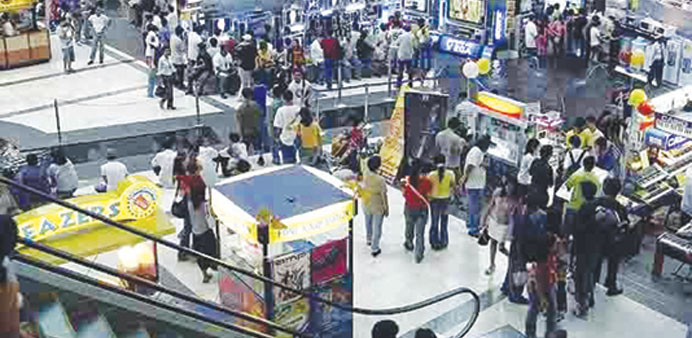
Customers at a mall in the Philippines.