


|
|
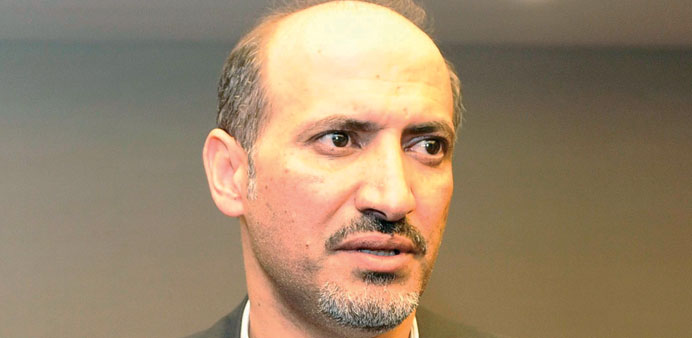
Syria’s main opposition yesterday elected Ahmed Assi Jarba to lead the movement which groups opponents of President Bashar al-Assad, spokesman Khaled Saleh said.
Jarba, who represents the faction of veteran secular dissident Michel Kilo and who is seen as close to Saudi Arabia, obtained 55 votes in the deeply divided Syrian National Coalition.
He edged out the group’s secretary general Mustafa al-Sabbagh, who obtained 52 votes in the second round of balloting at the group’s meeting in Istanbul.
The opposition had been rudderless since the departure in May of Ahmed Moaz al-Khatib in protest at the world’s “inaction” over Syria’s civil war.
The selection of a new chief had initially been mooted for the end of May but was postponed after eight days of talks were stalled by conflicting views on the future direction of the coalition.
During yesterday’s vote, the 114 members of the coalition also elected three vice presidents—Suheir Atassi, Mohamed Farouk Tayfur and Salim Muslit.
Badr Jamous was voted secretary general of the umbrella organisation recognised by dozens of states and organisations as the legitimate representative of the Syrian people.
Saleh said Jarba would not make a statement yesterday “due to the gravity of the situation in Homs”, the central Syrian city which was suffering an eighth straight day of assault from Assad’s troops.
Troops loyal to President Bashar al-Assad seized several buildings on the edges of rebel-held districts of Homs, activists said yesterday.
The army launched its all-out assault last Saturday, subjecting rebel-held areas to continuous bombardment.
“The most heated battles are taking place on the Khaldiyeh and Bab Hud fronts,” Homs-based activist Yazan told AFP via the Internet.
“Starting Friday, regime troops started to advance slowly, seizing several buildings on the edges of Khaldiyeh district,” the activist said.
Syria’s state news agency Sana said the army captured several buildings in Bab Hud in the city centre.
Rebel-held areas of Homs have been under siege by the regime’s military for more than a year.
“The situation is very difficult here. If nothing changes, Homs will fall,” Yazan said.
The activist also reported “the collapse of several buildings” because of the shelling, adding that an unknown number of civilians were trapped under the rubble.
Warplanes also launched air raids on the city dubbed “the capital of the revolution” by anti-Assad activists, said the Syrian Observatory for Human Rights.
It reported shelling of the already damaged, landmark mosque of Khaled Ibn al-Waleed.
On Friday Rupert Colville, spokesman for UN High Commissioner for Human Rights Navi Pillay, expressed extreme concern “about the human rights and humanitarian impact” of the regime assault on Homs.
The UN believes some 2,500 to 4,000 people are trapped in the besieged areas, and urges “unrestricted and immediate humanitarian access to all conflict-affected populations in besieged areas”.
Elsewhere, warplanes launched air strikes on the outskirts of Damascus as fighting erupted in several flashpoint areas, said the Britain-based Observatory.