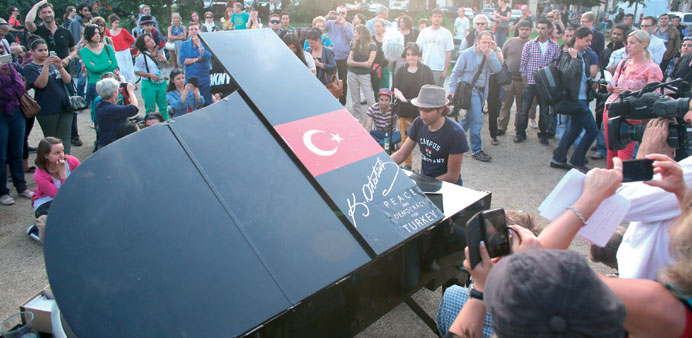
German pianist Davide Martello playing his piano earlier this week to show solidarity with protesters in Turkey as part of a flashmob on Oranienplatz in Berlin. Martello played the piano during the protests on Taksim Square in Istanbul.
Reuters/AFP/Istanbul
Turkish police fired teargas and water cannon to disperse hundreds of protesters in a central Istanbul square yesterday as they gathered to enter a park that was the centre of protests against Prime Minister Recep Tayyip Erdogan last month.
The Taksim Solidarity Platform, combining an array of political groups, had called a march to enter the sealed off Gezi park, but the governor of Istanbul warned any such gathering would be confronted by the police.
Riot police chased protesters off into side streets in what appeared to be the biggest police intervention since the protests and riots of mid-June that saw Taksim Square sealed off by makeshift barriers. Several people were detained.
A police crackdown on a group protesting against the planned redevelopment of Gezi Park, a leafy corner of Taksim, triggered nationwide protests last month against Erdogan, accused by critics of increasingly authoritarian rule after a decade in power.
Residents feared the redevelopment plan would turn the area into a shopping district, while urban planners and ecologists said the proposals did not respect the environment.
Turkish Halk TV showed protesters at Taksim square standing in front of riot police displaying a court decision cancelling plans for a replica Ottoman-era barracks on Taksim Square.
The development is one of a string of ambitious projects fostered by Erdogan, also including a canal to parallel the Bosphorus waterway, a huge international airport and a giant mosque.
Authorities can appeal against the court ruling, which was considered a victory for the protesters and a blow for Erdogan who stood fast against protests and riots he said were stoked by terrorists and looters.
Erdogan has carried out sweeping changes since he was elected in 2002 at the head of a party combining nationalists and reformers as well as Islamist elements.
He had curbed the power of an army that had toppled four governments in 40 years and carried out some liberal social and economic reforms.
But critics, outside the party and some within, had grown increasingly uneasy at what they felt to be an authoritarian style.
At the height of the protests he appeared to appeal increasingly to the Islamist and nationalist core of his party, further alienating secularists and other groups.
Four people were killed and some 7,500 wounded in the June police crackdown, according to the Turkish Medical Association. It largely ended when police cleared a protest camp on the square on June 15.
Istanbul governor Huseyn Avni Mutlu said the authorities had not given permission for the rally.
“Our constitution allows staging demonstrations without giving notification, but the legislation says that applying to the authorities for permission is mandatory,” Mutlu said, announcing on his twitter account that the Gezi Park would be open to public today. “I cannot act against the law. So we won’t allow these gatherings.”
He added: “Parks are not places for protests. They must serve as a place of calm and tranquility for all people.”
Europe rights chief urges investigation
AFP/Ankara
The Council of Europe’s human rights commissioner Nils Muiznieks has urged an investigation into the use of excessive police force during a crackdown on anti-government protests in Turkey last month.
“All instances of excessive use of force by the police must be fully investigated and adequately punished,” Muiznieks told a press conference during a five-day visit to Turkey.
His visit comes after unprecedented protests against Prime Minister Recep Tayyip Erdogan’s Islamic-rooted government in June which saw some 2.5mn take to the streets.
Four people were killed and 8,000 injured as police violently cracked down on the demonstrations, which began as a sit-in against plans to redevelop Istanbul’s Gezi Park, but snowballed into nationwide protests.
Muiznieks said his visit to the country, considered a model of democracy in a majority Muslim nation, was planned long before the protests broke out.
He said the only way to allow a healing process in Turkey “is to conduct independent, impartial, and effective investigations, with the involvement of victims, into all allegations of misconduct by security forces”.
The commissioner deplored the fact that only three police officers had been suspended, despite numerous accusations of rights abuses.
Muiznieks also urged authorities to guard against a campaign of intimidation against doctors, lawyers, journalists and academics who took part in the demonstrations between May 31 and mid-June.
He will present a report to the Council of Europe in autumn.