


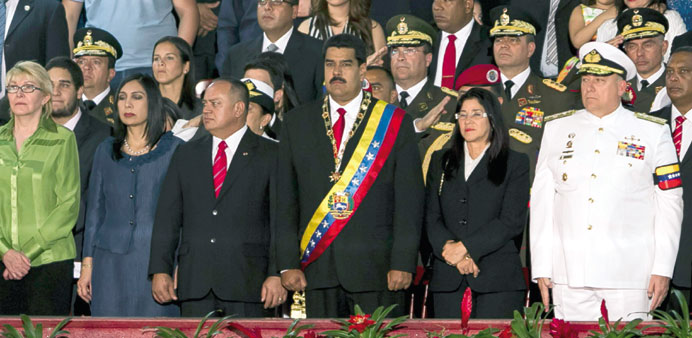
Venezuelan President Nicolas Maduro participates in the nation’s 202 independence anniversary celebrations in Caracas on Friday.
Reuters/La Paz/Caracas
Bolivia yesterday offered asylum to former US spy agency contractor Edward Snowden, joining leftist allies Venezuela and Nicaragua in defiance of Washington, which is demanding his arrest for divulging details of secret US surveillance programmes.
Snowden, 30, is believed to be holed up in the transit area of Moscow’s Sheremetyevo international airport and has been trying to find a country that would take him since he landed from Hong Kong on June 23.
Bolivian President Evo Morales had said earlier this week that he would consider granting asylum to Snowden.
But he took a harder line yesterday, angered that some European countries banned his plane from their airspace this week on suspicion it carried Snowden.
“I want to tell ... the Europeans and Americans that last night I was thinking that as a fair protest, I want to say that now in fact we are going to give asylum to that American who is being persecuted by his fellow Americans,” Morales said during a visit to the town of Chipaya.
“If we receive a legal request, we will grant asylum,” he said. Bolivia’s Foreign Ministry was not immediately available to comment on whether a formal asylum request had been received.
Venezuelan President Nicolas Maduro also offered refuge to Snowden late on Friday and Nicaraguan President Daniel Ortega said his country had received an asylum request and could agree to it “if circumstances permit.”
Russia has kept the former National Security Agency contractor at arm’s length, saying the transit area where passengers stay between flights is neutral territory and he would be on Russian soil only if he went through passport control.
It was not immediately clear how Snowden would react to the new offers from Latin America, nor reach the countries if he accepted.
There are no direct commercial flights between Moscow and Venezuela’s capital, Caracas, and the usual route involves changing planes in Havana. It is not clear if Cuban authorities would let him transit, however, and there was no sign of Snowden aboard the flight to Havana yesterday.
To obtain refugee status in Bolivia, Snowden would have to submit a request to the Bolivian Embassy in Russia and would not have to be physically in Bolivian territory, said former foreign minister Armando Loayza.
Ecuador, which also backs Snowden, has said it could only consider granting asylum once the fugitive landed on Ecuadorean soil.
Given the dramatic grounding in Vienna of Morales’ plane, using European airspace could prove problematic.
Russia has shown signs of growing impatience over Snowden’s stay in Moscow. Its deputy foreign minister said on Thursday that Snowden had not sought asylum in that country and needed to choose a place to go.
Moscow has made clear that the longer he stays, the greater the risk of the diplomatic standoff over his fate causing lasting damage to relations with Washington.
Both Russia’s Foreign Ministry and President Vladimir Putin’s spokesman declined to comment on Venezuela’s offer. “This is not our affair,” spokesman Dmitry Peskov told Reuters.
But senior pro-Kremlin lawmaker Alexei Pushkov, head of the international affairs committee of Russia’s lower house of parliament, said asylum in Venezuela would be Snowden’s best option.
WikiLeaks, the anti-secrecy organisation, said on Friday that Snowden had asked six more nations for asylum, bringing to about 20 the number of countries he has appealed to for protection from US espionage charges.
WikiLeaks said on Twitter it would not reveal which six new countries Snowden had applied to for asylum, due to “attempted US interference.”
Morales, Bolivia’s first indigenous leader and a former union leader for the country’s coca leaf farmers, and Maduro both condemned the US spy programmes that Snowden revealed and said he deserved protection.
“Who is the guilty one? A young man ... who denounces war plans, or the US government which launches bombs and arms the terrorist Syrian opposition against the people and legitimate President Bashar al-Assad?” Maduro asked, to applause and cheers from ranks of military officers at a parade. “Who is the terrorist? Who is the global delinquent?”
Since narrowly winning a presidential election in April that followed the death of his mentor, Hugo Chavez, from cancer, Maduro has often lambasted the US - even accusing the Pentagon and former US officials of plotting to kill him.
But the former bus driver and union leader has at times also struck a much more conciliatory note, saying he is ready for better relations with Washington, based on mutual respect.
Already one of Snowden’s most vocal supporters on the world stage, Maduro has sharpened his rhetoric in recent days.
Latin America’s leftist leaders denounced the diversion of Morale’s plane over European airspace as a disgrace and a serious breach of protocol, and Maduro said the CIA, the US spy agency, was behind it all.
Snowden had revealed that the US was spying on its European allies, Maduro said on Friday, and yet European leaders still caved under US pressure to ground Morales’ jet.
“The European people have seen the cowardice and the weakness of their governments, which now look like colonies of the US,” the Venezuelan president said.
Venezuela’s opposition leader, Henrique Capriles, accused Maduro of making a fuss about Snowden to distract voters from a dismal economic picture at home, and a host of other problems including one of the highest murder rates in the world.
“Nicolas, you can’t use asylum to cover up that you stole the election. That doesn’t give you legitimacy, nor make the people forget,” Capriles said on Twitter.
Speaking in Managua, Ortega said he would gladly give Snowden asylum in Nicaragua “if circumstances permit.” He did not say what those circumstances might be. Nicaragua, one of the poorest countries in the Americas, has benefited greatly from financial support from Venezuela, and Ortega was a staunch ally of Chavez.
A bid by Snowden for Icelandic citizenship hit an impasse on Friday when the country’s parliament voted not to debate the issue before its summer recess.